Overview
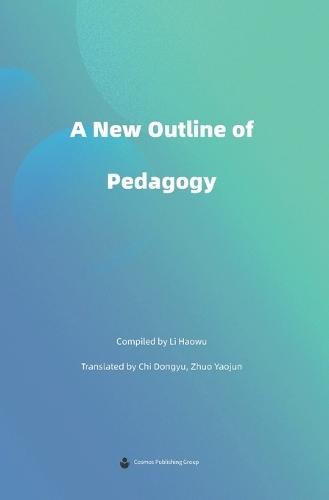
A New Outline of Pedagogy, stands as a pivotal work in 20th-century Chinese educational studies, this book challenges conventional educational discourse through a Marxist lens, offering a critical reevaluation of education's essence, evolution, and societal role. Rooted in historical materialism, the text rejects idealized notions of education as sacred, neutral, or independent. Instead, it defines education as a superstructure-""one of the fields of ideological labour""-shaped by economic systems and class dynamics. Li argues that education's original purpose, facilitating collective social survival in primitive communist societies, was transformed with the emergence of private property and class divisions. This transformation gave rise to five defining features of class-based education: the separation of learning and labor, educational rights tied to property ownership, service to ruling-class interests, antagonism between dominant and marginalized educational systems, and gender inequality in access and content. The book is structured into three core sections. Chapter 1 dissects education's essence, critiquing distortions like the ""sanctity of education"" and ""educational omnipotence"" while emphasizing its practical, class-bound nature. Chapter 2 traces educational evolution across societal formations-from universal, labor-integrated education in primitive communism to feudalism's religious and aristocratic schooling, capitalist education's commodification and monopolization, and the revolutionary potential of socialist education. Chapter 3 broadens the scope to explore education's intersections with economy, politics, teachers, students, and international movements, highlighting how education acts as both a tool of domination and a site of resistance. Li's work distinguishes itself by debunking bourgeois educational myths. It rejects the idea of education as a neutral force for national salvation or individual uplift, instead framing it as a weapon in class struggle. The text advocates for proletarian education that reunites learning and labor, prioritizes collective interests, and challenges capitalist hegemony. Drawing on global examples-from British labor education movements to Soviet unified labor schools-Li underscores the need for education to serve revolutionary transformation and the construction of a classless society. A key strength lies in its critical engagement with educational systems worldwide. It examines American education's plutocratic control, European feudalism's religious indoctrination, and China's own feudal educational legacy, urging readers to recognize education's role in reproducing or challenging social inequalities. The book also addresses contemporary issues such as teacher exploitation, student activism, and the commodification of knowledge, making it relevant beyond its historical context. More than a theoretical treatise, A New Outline of Pedagogy is a call to action. It encourages educators, students, and workers to reclaim education as a tool for liberation, emphasizing that true educational reform can only be achieved through broader social revolution. By exposing the class biases of mainstream education and outlining a vision for socialist education, Li Haowu's work remains a vital resource for critical educational studies and revolutionary thought.
Full Product Details
Author: Dongyu Chi ,
Yaojun Zhuo ,
Haowu Li
Publisher: Cosmos Publishing Group Inc
Imprint: Cosmos Publishing Group Inc
Dimensions:
Width: 13.30cm
, Height: 2.20cm
, Length: 20.30cm
Weight: 0.435kg
ISBN: 9798902080312
Pages: 420
Publication Date: 23 December 2025
Audience:
General/trade
,
General
Format: Paperback
Publisher's Status: Active
Availability: Available To Order

We have confirmation that this item is in stock with the supplier. It will be ordered in for you and dispatched immediately.