|
|
|||
|
||||
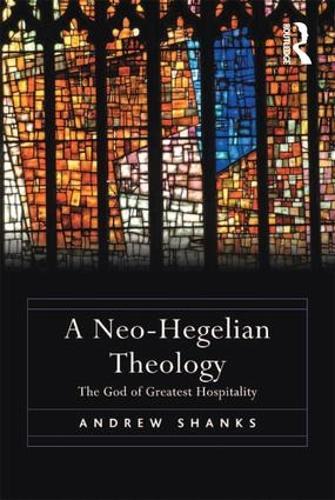
OverviewFull Product DetailsAuthor: Andrew ShanksPublisher: Taylor & Francis Ltd Imprint: Routledge Edition: New edition Dimensions: Width: 15.60cm , Height: 1.10cm , Length: 23.40cm Weight: 0.430kg ISBN: 9781472410870ISBN 10: 1472410874 Pages: 158 Publication Date: 20 February 2014 Audience: College/higher education , General/trade , Tertiary & Higher Education , General Format: Hardback Publisher's Status: Active Availability: In Print This item will be ordered in for you from one of our suppliers. Upon receipt, we will promptly dispatch it out to you. For in store availability, please contact us. Table of ContentsIntroduction; Chapter 1 ‘Heresy’; Chapter 2 Renewed Apologetics; Chapter 3 Anti-propaganda; Chapter 4 Hegel on History-as-Revelation; Chapter 5 ‘Where Did It All Go Wrong?’;Reviews'In his new book, Andrew Shanks offers a fresh perspective for his interpretation of truth-as-openness and its application to current controversies in the Church of England. This perspective is based on Hegel's distinction between two modes of divine revelation, that of violence , in which the divine will imposes itself directly and forcefully on human activity, and that of the cunning of reason , whereby God's will is mediated through the historical process as a whole, which is in itself ambiguous and requires constant discernment on the part of the interpreter. Shanks makes fruitful and creative use of this distinction in a book that deserves a wide readership in the Anglican community and beyond.' Peter C. Hodgson, Vanderbilt University, USA 'This bravura performance confirms Shanks's status as one of the most adventurous and challenging theologians at work today.' Church Times 'In his new book, Andrew Shanks offers a fresh perspective for his interpretation of truth-as-openness and its application to current controversies in the Church of England. This perspective is based on Hegel's distinction between two modes of divine revelation, that of violence, in which the divine will imposes itself directly and forcefully on human activity, and that of the cunning of reason, whereby God's will is mediated through the historical process as a whole, which is in itself ambiguous and requires constant discernment on the part of the interpreter. Shanks makes fruitful and creative use of this distinction in a book that deserves a wide readership in the Anglican community and beyond.' Peter C. Hodgson, Vanderbilt University, USA Author InformationAndrew Shanks's career has alternated between the academic and the ecclesiastical world. He has published nine previous works of philosophical theology, most recently including Hegel and Religious Faith: Divided Brain, Atoning Spirit (2011). He is currently Canon Emeritus at Manchester Cathedral having retired. Tab Content 6Author Website:Countries AvailableAll regions |
||||