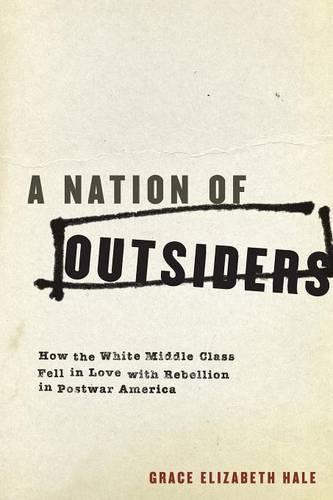
Full Product Details
Author: Grace Elizabeth Hale (Professor of History and American Studies, Professor of History and American Studies, University of Virginia)
Publisher: Oxford University Press Inc
Imprint: Oxford University Press Inc
Dimensions:
Width: 15.50cm
, Height: 2.80cm
, Length: 23.10cm
Weight: 0.567kg
ISBN: 9780199314584
ISBN 10: 0199314586
Pages: 404
Publication Date: 03 April 2014
Audience:
General/trade
,
Adult education
,
General
,
Further / Higher Education
Format: Paperback
Publisher's Status: Active
Availability: To order

Stock availability from the supplier is unknown. We will order it for you and ship this item to you once it is received by us.
Reviews
Wide ranging and engagingly written, A Nation of Outsiders is one of the most provocative works in post-World War II U.S. history published in recent years. --Journal of American History A Nation of Outsiders is smart, insightful, and politically astute. Grace Hale's analysis of the 'romance of the outsider' is necessary reading for anyone who has ever wondered about the meaning of our national obsession with 'authenticity'-as well as for anyone who might be curious about what Jerry Falwell and Holden Caulfield have in common. --Beth Bailey, Temple University In addition to telling a wealth of perceptively rendered stories, Grace Hale understands, as do few historians, that American rebels should neither be understood simply, with empathy, on their own terms nor viewed, often condescendingly, by the mainstream social order. No one before has woven these individual narratives into a larger analysis of how white middle-class rebels both rejected, in romantic ways, what they took to be established, oppressive norms while also helping to generate a more flexible, more profitable consumer society. In so doing, Hale makes A Nation of Outsiders required reading for anyone curious about the role and definition of rebellion in recent U.S. history. --Michael Kazin, Georgetown University A Nation of Outsiders provides a provocative and lively addition to the growing sense that postwar America was far less homogenous and consensual than the white bread postwar suburban stereotype suggests. Grace Elizabeth Hale carries her story forward to suggest how some of this 'rebellion' has cropped up in new and unexpected places in contemporary America. An important correction to the notion that the spirit of rebellion was limited to the 1960s or confined to those on the left. --Alexander Bloom, co-editor of Takin' to the Streets: A Sixties Reader For a nation whose history is so deeply saturated by white supremacy, Americans have paid an awful
For a nation whose history is so deeply saturated by white supremacy, Americans have paid an awful lot of attention to the disaffections of a wide array of self-proclaimed white outsiders and underdogs. Grace Elizabeth Hale provides a rich and intelligent account of how alienated-often fully aggrieved-marginality became the mainstream in post-war U.S. culture, from Holden Caulfield, the Beats, and the new minstrelsy of rock 'n' roll, to William F. Buckley and the white grievances of the Moral Majority. It's as if white Americans across the political spectrum had been rehearsing responses to the Obama presidency for two generations. This is an important book, not only for what it says about our past, but what it suggests about our present and our future as well. * Matthew Frye Jacobson, author of Roots Too: White Ethnic Revival in Post-Civil Rights America * A Nation of Outsiders provides a provocative and lively addition to the growing sense that postwar America was far less homogenous and consensual than the white bread postwar suburban stereotype suggests. Grace Elizabeth Hale carries her story forward to suggest how some of this 'rebellion' has cropped up in new and unexpected places in contemporary America. An important correction to the notion that the spirit of rebellion was limited to the 1960s or confined to those on the left. * Alexander Bloom, co-editor of Takin' to the Streets: A Sixties Reader * In addition to telling a wealth of perceptively rendered stories, Grace Hale understands, as do few historians, that American rebels should neither be understood simply, with empathy, on their own terms nor viewed, often condescendingly, by the mainstream social order. No one before has woven these individual narratives into a larger analysis of how white middle-class rebels both rejected, in romantic ways, what they took to be established, oppressive norms while also helping to generate a more flexible, more profitable consumer society. In so doing, Hale makes A Nation of Outsiders required reading for anyone curious about the role and definition of rebellion in recent U.S. history. * Michael Kazin, Georgetown University * A Nation of Outsiders is smart, insightful, and politically astute. Grace Hale's analysis of the 'romance of the outsider' is necessary reading for anyone who has ever wondered about the meaning of our national obsession with 'authenticity'-as well as for anyone who might be curious about what Jerry Falwell and Holden Caulfield have in common. * Beth Bailey, Temple University * Wide ranging and engagingly written, A Nation of Outsiders is one of the most provocative works in post-World War II U.S. history published in recent years. * Journal of American History *
Wide ranging and engagingly written, A Nation of Outsiders is one of the most provocative works in post-World War II U.S. history published in recent years. Journal of American History A Nation of Outsiders is smart, insightful, and politically astute. Grace Hale's analysis of the 'romance of the outsider' is necessary reading for anyone who has ever wondered about the meaning of our national obsession with 'authenticity'-as well as for anyone who might be curious about what Jerry Falwell and Holden Caulfield have in common. Beth Bailey, Temple University In addition to telling a wealth of perceptively rendered stories, Grace Hale understands, as do few historians, that American rebels should neither be understood simply, with empathy, on their own terms nor viewed, often condescendingly, by the mainstream social order. No one before has woven these individual narratives into a larger analysis of how white middle-class rebels both rejected, in romantic ways, what they took to be established, oppressive norms while also helping to generate a more flexible, more profitable consumer society. In so doing, Hale makes A Nation of Outsiders required reading for anyone curious about the role and definition of rebellion in recent U.S. history. Michael Kazin, Georgetown University A Nation of Outsiders provides a provocative and lively addition to the growing sense that postwar America was far less homogenous and consensual than the white bread postwar suburban stereotype suggests. Grace Elizabeth Hale carries her story forward to suggest how some of this 'rebellion' has cropped up in new and unexpected places in contemporary America. An important correction to the notion that the spirit of rebellion was limited to the 1960s or confined to those on the left. Alexander Bloom, co-editor of Takin' to the Streets: A Sixties Reader For a nation whose history is so deeply saturated by white supremacy, Americans have paid an awful lot of attention to the disaffections of a wide array of self-proclaimed white outsiders and underdogs. Grace Elizabeth Hale provides a rich and intelligent account of how alienated-often fully aggrieved-marginality became the mainstream in post-war U.S. culture, from Holden Caulfield, the Beats, and the new minstrelsy of rock 'n' roll, to William F. Buckley and the white grievances of the Moral Majority. It's as if white Americans across the political spectrum had been rehearsing responses to the Obama presidency for two generations. This is an important book, not only for what it says about our past, but what it suggests about our present and our future as well. Matthew Frye Jacobson, author of Roots Too: White Ethnic Revival in Post-Civil Rights America
Author Information
Grace Elizabeth Hale is Professor of History and American Studies at the University of Virginia. She is the author of Making Whiteness: The Culture of Segregation in the South, 1890-1940.