Overview
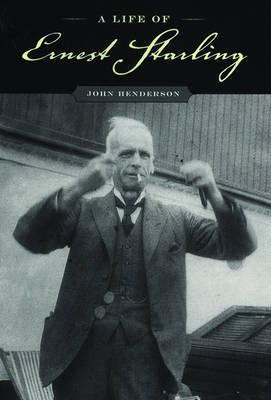
Ernest Starling (1866-1927) was pre-eminent in the golden age of British Physiology. His name is usually associated with his ""Law of the Heart,"" but his discovery of secretin (the first hormone whose mode of action was explained) and his work on capillaries were more important contributions. He coined the word 'hormone' one hundred years ago. His analysis of capillary function demonstrated that equal and opposite forces move across the capillary wall--an outward (hydrostatic) force and an inward (osmotic) force derived from plasma proteins. Starling's contributions include: *Developing the ""Frank-Starling Law of the Heart,"" presented in 1915 and modified in 1919. *The Starling equation, describing fluid shifts in the body (1896) *The discovery of secretin, the first hormone, with Bayliss (1902) and the introduction of the concept of hormones (1905).
Full Product Details
Author: John Henderson
Publisher: Oxford University Press
Imprint: Oxford University Press
Dimensions:
Width: 15.20cm
, Height: 1.70cm
, Length: 22.90cm
Weight: 0.520kg
ISBN: 9780195177800
ISBN 10: 0195177800
Pages: 227
Publication Date: 17 October 2008
Audience:
Professional and scholarly
,
Professional & Vocational
Format: Hardback
Publisher's Status: Active
Availability: To order

Stock availability from the supplier is unknown. We will order it for you and ship this item to you once it is received by us.
Reviews
Journal of the History of Medicine and Allied Sciences 61.2 (2006) 240-242 John Henderson's biography of Ernest Starling gives breadth and vitality to a subject that in the hands of a less gifted biographer could have been primarily an account of research projects and their data. A Life of Ernest [End Page 240] Starling presents an engaging narrative that has much to recommend it. Henderson, himself a physiologist, has a firm grasp of the clinical aspects necessary to render the details of Starling's work. Concurrently, he conveys a sense of genuine appreciation and admiration for his subject on a personal, humane level. Henderson feels that Starling was never appropriately honored for his contributions to physiology and medical science. He also feels that previous biographies of this remarkable man failed to adequately integrate the clinical, personal, and political aspects of his life. These deficiencies are addressed in this diligently researched, skillfully organized, and refreshingly readable review of Starling's life. In addition, the appendices list Starling's voluminous output of publications in chronological order and provide an...
Journal of the History of Medicine and Allied Sciences 61.2 (2006) 240-242 John Henderson's biography of Ernest Starling gives breadth and vitality to a subject that in the hands of a less gifted biographer could have been primarily an account of research projects and their data. A Life of Ernest [End Page 240] Starling presents an engaging narrative that has much to recommend it. Henderson, himself a physiologist, has a firm grasp of the clinical aspects necessary to render the details of Starling's work. Concurrently, he conveys a sense of genuine appreciation and admiration for his subject on a personal, humane level. Henderson feels that Starling was never appropriately honored for his contributions to physiology and medical science. He also feels that previous biographies of this remarkable man failed to adequately integrate the clinical, personal, and political aspects of his life. These deficiencies are addressed in this diligently researched, skillfully organized, and refreshingly readable review of Starling's life. In addition, the appendices list Starling's voluminous output of publications in chronological order and provide an...
Journal of the History of Medicine and Allied Sciences 61.2 (2006) 240-242 John Henderson's biography of Ernest Starling gives breadth and vitality to a subject that in the hands of a less gifted biographer could have been primarily an account of research projects and their data. A Life of Ernest [End Page 240] Starling presents an engaging narrative that has much to recommend it. Henderson, himself a physiologist, has a firm grasp of the clinical aspects necessary to render the details of Starling's work. Concurrently, he conveys a sense of genuine appreciation and admiration for his subject on a personal, humane level. Henderson feels that Starling was never appropriately honored for his contributions to physiology and medical science. He also feels that previous biographies of this remarkable man failed to adequately integrate the clinical, personal, and political aspects of his life. These deficiencies are addressed in this diligently researched, skillfully organized, and refreshingly readable review of Starling's life. In addition, the appendices list Starling's voluminous output of publications in chronological order and provide an...