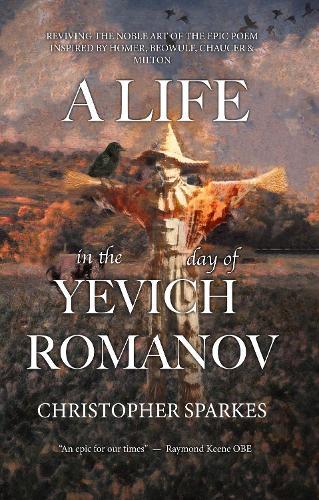
Overview
Original, inventive, with linguistic somersaults taking centre stage on every page. Who’d imagine a humble scarecrow being raised to such literary heights? Chris Sparkes has created a heart-felt tour de force in his Life in the Day of Yevich Romanov. Scaretits, hold on tight to your straw hats! Maggie Sawkins A feast of tactile rhythms and chewy language. Oracular lines of poetry flow in a vernacular speech spiced with grandeur, honouring a great resonant subject, the birth of perhaps a redeemer. Extraordinary. George Marsh Epic poetry might be considered a prehistoric art form, the stuff of long dead white authors, such as Homer, Virgil, Dante and Milton, the dread and terror of English A level students. It is no accident that much of such epic poetry takes place physically in the realms of the dead, with visitations to Hades forming key components of The Odyssey, The Aeneid, The Divine Comedy, and, of course, Paradise Lost. In his new work Christopher Sparkes seeks to revive the Epic and imbue it with the breath of modern life, much as the 19thFrench poet Baudelaire exhorted pictorial artists to abandon the customary fêtes galantes, relegate them to the Neiges d’antan ofVillon, and focus instead on the rich seam of potential offered by the dynamic vibrancy of modern life.
Full Product Details
Author: Christopher Spakes
Publisher: Filament Publishing Ltd
Imprint: Filament Publishing Ltd
Dimensions:
Width: 22.90cm
, Height: 9.40cm
, Length: 15.20cm
Weight: 0.256kg
ISBN: 9781915465870
ISBN 10: 1915465877
Pages: 136
Publication Date: 01 August 2025
Audience:
General/trade
,
General
Format: Paperback
Publisher's Status: Active
Availability: Available To Order

We have confirmation that this item is in stock with the supplier. It will be ordered in for you and dispatched immediately.
Reviews
Raymond Keene OBEMA Trinity College Cambridge International Chess Grandmaster AN EPIC FOR OUR TIMES Epic poetry might be considered a prehistoric art form, the stuff of long dead white authors, such as Homer, Virgil, Dante and Milton, the dread and terror of English A level students. It is no accident that much of such epic poetry takes place physically inthe realms of the dead, with visitations to Hades forming keycomponents of The Odyssey, The Aeneid, The Divine Comedyand, of course, Paradise Lost. In his new work Christopher Sparkes seeks to revive the Epicand imbue it with the breath of modern life, much as the 19thcentury French poet Baudelaire exhorted pictorial artists toabandon the customary fětes galantes, relegate them to the Neigesd’antan of Villon, and focus instead on the rich seam of potentialoffered by the dynamic vibrancy of modern life. Epic narratives can come in various forms, such asShakespeare’s cycle of History plays. William Shakespeare is also,of course, an opulent source for verbal troves. He can be credited with many achievements, not least, in my opinion, with writing the key texts which actually created English national andlinguistic identity. Shakespeare’s play Henry VIII brings to a close the mightyhistory cycle commencing with Edward III. The latter is nowgenerally regarded as, at least partly, a Shakespeare original, andone of the very few which specifically mention chess:“And bid the lords hold on their play at chess,For we will walk and meditate alone.”(Scene 3 in the Royal Shakespeare Company edition.) The cycle continues with Richard II, Henry IV Parts One andTwo, Henry V, Henry VI Parts One, Two and Three, and RichardIII. It is my opinion that this huge dramatic cycle, essentially onelong play, represents the true English national epic in a way that i -ii-Beowulf (too early in our national lifeline) and Paradise Lost (tooLatinate for most readers, though a treat for those who like theirEnglish poetry in a Latin word order) do not. If I am correct, then the Shakespeare histories together createour epic poem of national identity, on a par with Homer’s Iliadand Odyssey, Virgil’s Aeneid, Dante’s Divine Comedy, the WelshMabinogion, Finland’s Kalevala, Portugal’s Lusiads and, for theHebrew people, the epic story of the Hebrew Bible, or OldTestament. In the course of his plays and poetry Shakespeare deployed avocabulary of around 35,000 words. This is a global record, apartfrom that Olympic level logodaedalus, James Joyce, whooperated with a staggering vocabulary in Finnegans Wake of over64,000 words. However, many of these were one-off inventions,never since revived and incomprehensible to the multitude, notso much caviar to the general as gibberish to almost everyone,apart from Joycean scholars ensconced in their most adamantineof ivory towers. In practice, even the most literate of English speakers tend tooperate within a maximum of 15,000 words, with the averagebeing in the range 3,000-5,000. Enhanced vocabulary liberatesthinking and creativity, equating freedom of expression withbreadth of thinking and outreach of communication potential. However, we now largely inhabit an increasingly reductivecommunicative environment, a hostile territory now challengedby Sparkes, who boldly rejects a largely non-verbal landscape, dominated by emojis, icons and abbreviations, with would-beaspirations to eloquence arbitrarily truncated in Tweets to aprescribed maximum of characters. One might describe it asverbal grunting, rather than efflorescence, with the fullexpression of cerebration now widely regarded as an evil to beavoided at best, or ignored at worst. Fortunately, our new worshipper at the shrine of Homer andhis poetic descendants represents an oasis in this wasteland.Brevity may be the soul of wit, but this does not necessarily implythat unexpurgated expression, as practised in the following pages,is anathema to our little grey cells.A Life in the Day of Yevich Romanov is, as noted above, written by Christopher Sparkes – a fresh voice in the revival of the Epic.Sparkes has already devoted 28 years towards creating a new ii -iii-English translation of the Bible. His Epic Poem is deeply imbuedwith classical, humanist and Christian symbolism and it payscoruscating homage to other examples of the epic form such asMilton’s Paradise Lost. Yevich Romanov follows in the footstepsof Homer’s Odysseus, the Anglo-Saxon Beowulf and other heroesof the genre, which typically create the totality of the life of aman and flesh it out with multiple new dimensions. Epic poems famously depict the experiences of a hero, in thiscase Yevich Romanov, in a struggle to overcome the hostileforces that try to prevent his success, whether it be in battle, inlove, in the attainment of enlightenment or remaining true to hismoral principles. All of the great challenges of human existenceconfront Yevich Romanov, as he anticipates the arrival of hisfirst child and ponders the meaning of human life. As with Milton’s epic poem Paradise Lost, there is a timelessquality to the depiction of Romanov’s life in Ephanerothee.There are other parallels with Milton’s stupendous creation ofSatan, on the one hand a supernatural figure, on the otherinfused with human emotions and desires. The character of Yevich Romanov similarly hovers betweentwo conditions, his life as a scarecrow and his raw emotions as aman, husband and soon-to-be father. As the author tells us, hispoem could be set either in a distant age or in a post-AI worldthat has lost or forgotten earlier technologies. But ultimately Yevich Romanov is witness to and engaged by a battle betweengood and evil which has already claimed the life of his brotherPython, leaving him to wonder what sort of world his child willinherit. Before the advent of literacy and the written word, arrestingstories such as A Life in the Day of Yevich Romanov were often toldin the form of poetry, which could be easily memorised. Epicpoems called for prodigious feats of memory, though, and theywere performed by professional story tellers, bards and actors.For this reason, perhaps, the long epic poem is a much neglectedform in our age of tweets, instant information and AI-generatedtext. Yet we are increasingly recognising the value of deepengagement with the thoughts, knowledge and creations of otherpeople, both from the distant past and in our present age, asdemonstrated in Sparkes’s creation of A Life in the Day of Yevich Romanov.
Author Information
Author Website: http://https://www.keysofthekingdombible.com/about-christopher-sparkes/
Christopher Sparkes was born in Birmingham in 1951, and lives in East Hampshire, England. After lecturing in Higher and Further Education, he became a free-lance editor and educator. He has run Creative Writing groups for adults, a folk and poetry club, and managed a trout fishery. As well as publishing a translation of the Bible, The Keys of the Kingdom Holy Bible, and being co-author of textbooks on writing and grammar, he has published poetry, short fiction, academic essays on poetry and stylistics, reviews, and artwork. His other interests are cricket, trout fishing, cycling, oil painting, birdwatching, and playing the guitar and harmonica.