Overview
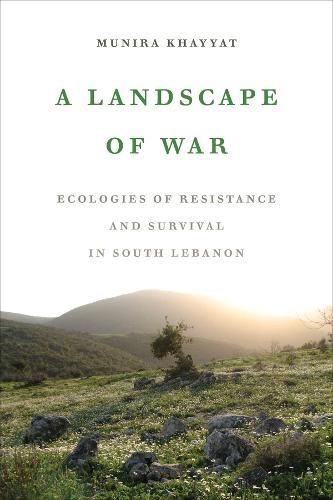
What worlds take root in war? In this book, anthropologist Munira Khayyat describes life along the southern border of Lebanon, where resistant ecologies thrive amid a terrain of perennial war. A Landscape of War takes us to frontline villages where armed invasions, indiscriminate bombings, and scattered land mines have become the environment where everyday life is waged. This book dwells with multispecies partnerships such as tobacco farming and goatherding that carry life through seasons of destruction. Neither green-tinged utopia nor total devastation, these ecologies make life possible in an insistently deadly region. Sourcing an anthropology of war from where it is lived, this book decolonizes distant theories of war and brings to light creative practices forged in the midst of ongoing devastation. In lyrical prose that resonates with imperiled conditions across the Global South, Khayyat paints a portrait of war as a place where life must go on.
Full Product Details
Author: Munira Khayyat
Publisher: University of California Press
Imprint: University of California Press
Dimensions:
Width: 15.20cm
, Height: 2.30cm
, Length: 22.90cm
Weight: 0.499kg
ISBN: 9780520389984
ISBN 10: 0520389980
Pages: 286
Publication Date: 22 November 2022
Audience:
Professional and scholarly
,
Professional & Vocational
Format: Hardback
Publisher's Status: Active
Availability: Out of stock

The supplier is temporarily out of stock of this item. It will be ordered for you on backorder and shipped when it becomes available.
Reviews
"""The staying power of this book is how it models a way to think outside accumulated disasters as discrete events, how to use ethnography to render life under a constant state of precarity and violence. Khayyat’s approach, ethnographic sensitivity, and relentless focus on “living with” rather than “living despite” scale up and apply broadly to accumulated crisis in both other locales and on a planetary scale."" * International Journal of Middle East Studies * ""A Landscape of War is a rich and daring ethnography. Ethically and politically committed to honoring the terms through which her interlocutors understand their vital and lethal environments, Khayyat conceptualizes war as a place of life and reclaims resistance as political action, highlighting its ordinary and relational nature. . . . a powerful and necessary meditation on the domesticity of war: war as something that is managed and that can be (to a certain extent) tamed, as well as a space that is inhabited, that bitterly becomes home."" * Current Anthropology *"
"""The staying power of this book is how it models a way to think outside accumulated disasters as discrete events, how to use ethnography to render life under a constant state of precarity and violence. Khayyat’s approach, ethnographic sensitivity, and relentless focus on “living with” rather than “living despite” scale up and apply broadly to accumulated crisis in both other locales and on a planetary scale."" * International Journal of Middle East Studies * ""A Landscape of War is a rich and daring ethnography. Ethically and politically committed to honoring the terms through which her interlocutors understand their vital and lethal environments, Khayyat conceptualizes war as a place of life and reclaims resistance as political action, highlighting its ordinary and relational nature. . . . a powerful and necessary meditation on the domesticity of war: war as something that is managed and that can be (to a certain extent) tamed, as well as a space that is inhabited, that bitterly becomes home."" * Current Anthropology * ""A Landscape of War is a rich ecological and historical study that also blends into the text the emotional imaginary of Munira Khayyat. It would be of interest to scholars and graduate students of anthropology, history, and war, sectarian, and cultural studies."" * Arab Studies Quarterly *"
Author Information
Munira Khayyat teaches Anthropology at the American University in Cairo.