Full Product Details
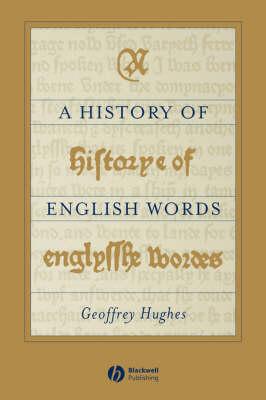
Author: Geoffrey Hughes (University of Witwatersrand, Johannesburg, South Africa)
Publisher: John Wiley and Sons Ltd
Imprint: Wiley-Blackwell
Edition: New edition
Dimensions:
Width: 15.50cm
, Height: 3.50cm
, Length: 22.90cm
Weight: 0.644kg
ISBN: 9780631188551
ISBN 10: 063118855
Pages: 452
Publication Date: 16 December 1999
Audience:
College/higher education
,
Professional and scholarly
,
Undergraduate
,
Professional & Vocational
Format: Paperback
Publisher's Status: Active
Availability: Available To Order

We have confirmation that this item is in stock with the supplier. It will be ordered in for you and dispatched immediately.
Reviews
Do not misprise this book by dipping into it; begin respectfully at the beginning and follow the signs, all the way from ancient kings to modern cabbages, through a long cultural tale that documents the words of Saxons and saints, soldiers and scholars, poets and politicians, admen, journalists, junkies and all that jazz. The compelling power of it is in the detail, and all the details are delightful. Walter Nash, University of Nottingham Geoffrey Hughes's book deals authoritatively with the origin and history of groups of English words from the eighth century to the end of the twentieth and also with the emergence of the first English dictionaries and of all the major ones that have been published since the early seventeenth century. It is packed with tables displaying the dates of first records, and the interconnections of all types of vocabulary from the most technical to the most colloquial. It will be of particular interest to members of the general public, to students embarking on an investigation of our language in the UK, the USA and other English-speaking countries, and to learners of the language elsewhere in the world. Robert Burchfield, Editor of A Supplement to the OED, four volumes 1972-86 This book has many useful things for the language teacher, of which three stand out: First: it offers insights into our language - its history, where its words come from and how they evolved. Second: it provides information on language syllabus topics; for example, register, word formation and roots. The third thing is enjoyment. I have read this book straight through twice, and dipped into various sections of it many times - it is as entertaining as it is informative. Hughes' writing has the lightness of touch and imagination that come from long and profound engagement with his subject. There is vast learning, lightly worn, in this book. Modern English Teacher Socialinguists will find the work a useful departure point for research and teaching, particularly where it deals with areas outside their current expertise, and students and generalists will find it a good read and highly informative throughout. Elizabeth Falsberg, English, University of Washington.
In this scholarly, but readable, book Professor Hughes provides an excellent introduction to the history of the English language and its vocabulary. He traces the evolution of the mother tongue from its Germanic origins, through the influence of Norman French and the borrowings from the classical languages during the Renaissance, to the Americanizing influences of the 20th century. He examines the coinage words and their evolving meanings as indicators of social change and symbols of new ideas. Hughes repeatedly illuminates the relationship between the way we speak and the world we inhabit. (Kirkus UK)
Do not misprise this book by dipping into it; begin respectfully at the beginning and follow the signs, all the way from ancient kings to modern cabbages, through a long cultural tale that documents the words of Saxons and saints, soldiers and scholars, poets and politicians, admen, journalists, junkies and all that jazz. The compelling power of it is in the detail, and all the details are delightful. Walter Nash, University of Nottingham <!----end----> Geoffrey Hughesa s book deals authoritatively with the origin and history of groups of English words from the eighth century to the end of the twentieth and also with the emergence of the first English dictionaries and of all the major ones that have been published since the early seventeenth century. It is packed with tables displaying the dates of first records, and the interconnections of all types of vocabulary from the most technical to the most colloquial. It will be of particular interest to members of the general public, to students embarking on an investigation of our language in the UK, the USA and other English--speaking countries, and to learners of the language elsewhere in the world. Robert Burchfield, Editor of A Supplement to the OED, four volumes 1972--86 This book has many useful things for the language teacher, of which three stand out: First: it offers insights into our language -- its history, where its words come from and how they evolved. Second: it provides information on language syllabus topics; for example, register, word formation and roots. The third thing is enjoyment. I have read this book straight through twice, and dipped into various sections of it many times -- it is as entertaining as it is informative. Hughesa writing has the lightness of touch and imagination that come from long and profound engagement with his subject. There is vast learning, lightly worn, in this book. Modern English Teacher Socialinguists will find the work a useful departure point for research and teaching, particularly where it deals with areas outside their current expertise, and students and generalists will find it a good read and highly informative throughout. Elizabeth Falsberg, English, University of Washington.
"Do not misprise this book by dipping into it; begin respectfully at the beginning and follow the signs, all the way from ancient kings to modern cabbages, through a long cultural tale that documents the words of Saxons and saints, soldiers and scholars, poets and politicians, admen, journalists, junkies and all that jazz. The compelling power of it is in the detail, and all the details are delightful." Walter Nash, University of Nottingham "Geoffrey Hughes's book deals authoritatively with the origin and history of groups of English words from the eighth century to the end of the twentieth and also with the emergence of the first English dictionaries and of all the major ones that have been published since the early seventeenth century. It is packed with tables displaying the dates of first records, and the interconnections of all types of vocabulary from the most technical to the most colloquial. It will be of particular interest to members of the general public, to students embarking on an investigation of our language in the UK, the USA and other English-speaking countries, and to learners of the language elsewhere in the world." Robert Burchfield, Editor of A Supplement to the OED, four volumes 1972-86 "This book has many useful things for the language teacher, of which three stand out: First: it offers insights into our language - its history, where its words come from and how they evolved. Second: it provides information on language syllabus topics; for example, register, word formation and roots. The third thing is enjoyment. I have read this book straight through twice, and dipped into various sections of it many times - it is as entertaining as it is informative. Hughes' writing has the lightness of touch and imagination that come from long and profound engagement with his subject. There is vast learning, lightly worn, in this book." Modern English Teacher "Socialinguists will find the work a useful departure point for research and teaching, particularly where it deals with areas outside their current expertise, and students and generalists will find it a good read and highly informative throughout." Elizabeth Falsberg, English, University of Washington.
Author Information
Geoffrey Hughes is Professor of the History of the English Language at the University of the Witwatersrand in Johannesburg, South Africa. A graduate of Oxford University, he has held academic and research posts at Cape Town, Harvard and Turin. His main interests are in historical semantics and sociolinguistics on which he has written over twenty papers and two books, Words in Time (Blackwell, 1988) and Swearing (Blackwell, 1991). He is a consultant for the Collins Dictionaries on South African English and has been editor of the journal English Studies in Africa.