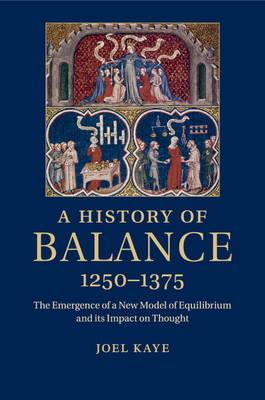
Full Product Details
Author: Joel Kaye (Barnard College, Columbia University)
Publisher: Cambridge University Press
Imprint: Cambridge University Press
Dimensions:
Width: 15.30cm
, Height: 2.80cm
, Length: 23.00cm
Weight: 0.770kg
ISBN: 9781316620281
ISBN 10: 131662028
Pages: 530
Publication Date: 23 June 2016
Audience:
Professional and scholarly
,
Professional & Vocational
Format: Paperback
Publisher's Status: Active
Availability: Manufactured on demand

We will order this item for you from a manufactured on demand supplier.
Reviews
'Simply stated, my enthusiasm for A History of Balance, 1250-1375 is boundless. Words such as 'transformative' and 'pathbreaking' do not adequately convey [Kaye's] accomplishment ... [His] synthetic vision renders coherent vast bodies of medieval literatures that one might suspect are integral to one another, but that no one before him has demonstrated so thoroughly and powerfully. I feel confident in saying that in decades hence, scholars will still be citing and drawing upon the insights offered by [this book]. I guarantee that [it] will profoundly inform my own future research on the intellectual history of the Middle Ages.' Cary J. Nederman, Renaissance Quarterly 'Through his analysis of the shifting sense of balance, Kaye opens up a fresh view on the history of ideas in the high and later Middle Ages, as well as a lens, he hopes, through which others might productively begin to examine the thought of other times and places. At every stage, the reader experiences a feeling of intellectual wonder not unlike that of a child holding up a kaleidoscope, as the 'pieces' of medieval thought fall into a new and beautiful array. A History of Balance, 1250-1375 is one of the most deeply satisfying works of intellectual history I have read in a long time.' Laura A. Smoller, The American Historical Review 'It is the spirit of the works of M. Bloch and Jacques Le Goff that is found here ... this magnificent work will live on as an indispensable reference. The model [of balance] now takes its place as a splendid object of historical investigation.' Alain Boureau, translated from Annales: Histoire, Sciences Sociales '... this is an exciting, deep, and detailed history of a medieval approach to understanding nature and society that achieved much before slowing down and fading in the 1370s ... Kaye's book convincingly shows that medieval models for understanding equilibrium and motion were present in medicine (traced back to Galen) before physics - and perhaps in ethics and economics even before that ... This book traces the history of a large part of scholastic philosophy from 1250 to 1375 - if this is a history of balance, it is a lot more besides.' Edith Dudley Sylla, Isis: A Journal of the History of Science Society 'Kaye's synthesis in A History of Balance, 1250-1375 is a powerful and persuasive new framework in which to understand the development of medieval intellectual life.' James Byrne, Early Science and Medicine 'In his intriguing and learned A History of Balance, 1250-1375, Joel Kaye lays out a bold and original account of intellectual transformation in the late Middle Ages. In impressive detail, he chronicles the formation of a model of equilibrium, or balance, in the minds and writings of late medieval thinkers. This model ... gave rise to strikingly novel ideas about the self-regulating actions of the human body, commerce, and politics. His study breaks new ground in its account of the subtle interplay of experience and thought in the work of these authors - they show the influence not only of ancient texts (especially Galen and Aristotle), but also of their own everyday experiences in the large commercial cities of Europe.' Pamela Smith, Columbia University 'Joel Kaye presents us with a masterful and beautifully crafted study of an original, hitherto unstudied topic in medieval scholastic thought that cuts through a plethora of fields of thinking. The resulting text is an inspiring account of the rise and fall of the 'new model of equilibrium or balance'. Kaye writes with admirable clarity, breadth, and subtlety, with all the skills of a first-rate intellectual historian. Historians and students will find reading this book a rewarding and stimulating task that will expose them to a complex and sophisticated argument and a major innovation to the traditional narrative of the history of medieval thought.' Joseph Ziegler, University of Haifa, Israel 'Riveting and astonishing. With the concept of dynamic equilibrium - balance achieved through change and instability - Joel Kaye reveals the new way that thinkers came to comprehend order and its attainment. Far from emphasizing stasis or harmony, late-medieval thought is shown as understanding nature and human institutions as shifting but self-regulating systems. Never has medieval Scholastic philosophical speculation been made to appear so fascinating, and never before have tricky notions of incommensurability, geometric progression and economic regulation been explained so lucidly. A History of Balance, 1250-1375 is a deep and startling page-turner.' Paul Freedman, Yale University, Connecticut 'Joel Kaye's study of different models of equilibrium developed by a wide range of leading thinkers in Europe in the late Middle Ages is highly stimulating. He writes interestingly, intriguingly, and clearly on ideas of balance in natural science, medicine, politics, economics, and finance, and finds many connections between them.' David Luscombe, University of Sheffield 'By weaving together ideas from medicine, economics, politics and natural philosophy, A History of Balance, 1250-1375 uncovers historically conditioned conceptual frameworks and thus sheds new light on the history of ideas of 1250-1375.' Christoph Flueler, University of Fribourg 'A powerful study of a line of thought that continues to echo in our own day. For a moment in history ... the free play of equal and interacting agents could determine both civil justice and the common good. Kaye offers a fascinating account of a moment in the constitution of ideas of public self-regulation and their decline.' Harold Cook, Brown University, Rhode Island
'Simply stated, my enthusiasm for A History of Balance, 1250-1375 is boundless. Words such as 'transformative' and 'pathbreaking' do not adequately convey [Kaye's] accomplishment ... [His] synthetic vision renders coherent vast bodies of medieval literatures that one might suspect are integral to one another, but that no one before him has demonstrated so thoroughly and powerfully. I feel confident in saying that in decades hence, scholars will still be citing and drawing upon the insights offered by [this book]. I guarantee that [it] will profoundly inform my own future research on the intellectual history of the Middle Ages.' Cary J. Nederman, Renaissance Quarterly 'Through his analysis of the shifting sense of balance, Kaye opens up a fresh view on the history of ideas in the high and later Middle Ages, as well as a lens, he hopes, through which others might productively begin to examine the thought of other times and places. At every stage, the reader experiences a feeling of intellectual wonder not unlike that of a child holding up a kaleidoscope, as the 'pieces' of medieval thought fall into a new and beautiful array. A History of Balance, 1250-1375 is one of the most deeply satisfying works of intellectual history I have read in a long time.' Laura A. Smoller, The American Historical Review 'It is the spirit of the works of M. Bloch and Jacques Le Goff that is found here ... this magnificent work will live on as an indispensable reference. The model [of balance] now takes its place as a splendid object of historical investigation.' Alain Boureau, translated from Annales: Histoire, Sciences Sociales '... this is an exciting, deep, and detailed history of a medieval approach to understanding nature and society that achieved much before slowing down and fading in the 1370s ... Kaye's book convincingly shows that medieval models for understanding equilibrium and motion were present in medicine (traced back to Galen) before physics - and perhaps in ethics and economics even before that ... This book traces the history of a large part of scholastic philosophy from 1250 to 1375 - if this is a history of balance, it is a lot more besides.' Edith Dudley Sylla, Isis: A Journal of the History of Science Society 'Kaye's synthesis in A History of Balance, 1250-1375 is a powerful and persuasive new framework in which to understand the development of medieval intellectual life.' James Byrne, Early Science and Medicine 'In his intriguing and learned A History of Balance, 1250-1375, Joel Kaye lays out a bold and original account of intellectual transformation in the late Middle Ages. In impressive detail, he chronicles the formation of a model of equilibrium, or balance, in the minds and writings of late medieval thinkers. This model ... gave rise to strikingly novel ideas about the self-regulating actions of the human body, commerce, and politics. His study breaks new ground in its account of the subtle interplay of experience and thought in the work of these authors - they show the influence not only of ancient texts (especially Galen and Aristotle), but also of their own everyday experiences in the large commercial cities of Europe.' Pamela Smith, Columbia University 'Joel Kaye presents us with a masterful and beautifully crafted study of an original, hitherto unstudied topic in medieval scholastic thought that cuts through a plethora of fields of thinking. The resulting text is an inspiring account of the rise and fall of the 'new model of equilibrium or balance'. Kaye writes with admirable clarity, breadth, and subtlety, with all the skills of a first-rate intellectual historian. Historians and students will find reading this book a rewarding and stimulating task that will expose them to a complex and sophisticated argument and a major innovation to the traditional narrative of the history of medieval thought.' Joseph Ziegler, University of Haifa, Israel 'Riveting and astonishing. With the concept of dynamic equilibrium - balance achieved through change and instability - Joel Kaye reveals the new way that thinkers came to comprehend order and its attainment. Far from emphasizing stasis or harmony, late-medieval thought is shown as understanding nature and human institutions as shifting but self-regulating systems. Never has medieval Scholastic philosophical speculation been made to appear so fascinating, and never before have tricky notions of incommensurability, geometric progression and economic regulation been explained so lucidly. A History of Balance, 1250-1375 is a deep and startling page-turner.' Paul Freedman, Yale University, Connecticut 'Joel Kaye's study of different models of equilibrium developed by a wide range of leading thinkers in Europe in the late Middle Ages is highly stimulating. He writes interestingly, intriguingly, and clearly on ideas of balance in natural science, medicine, politics, economics, and finance, and finds many connections between them.' David Luscombe, University of Sheffield 'By weaving together ideas from medicine, economics, politics and natural philosophy, A History of Balance, 1250-1375 uncovers historically conditioned conceptual frameworks and thus sheds new light on the history of ideas of 1250-1375.' Christoph Flueler, University of Fribourg 'A powerful study of a line of thought that continues to echo in our own day. For a moment in history ... the free play of equal and interacting agents could determine both civil justice and the common good. Kaye offers a fascinating account of a moment in the constitution of ideas of public self-regulation and their decline.' Harold Cook, Brown University, Rhode Island 'Kaye's book convincingly shows that medieval models for understanding equilibrium and motion were present in medicine (traced back to Galen) before physics - and perhaps in ethics and economics even before that: witness the impressive economic writings of Peter of John Olivi.' Edith Dudley Sylla, Isis
'Simply stated, my enthusiasm for A History of Balance, 1250-1375 is boundless. Words such as 'transformative' and 'pathbreaking' do not adequately convey [Kaye's] accomplishment ... [His] synthetic vision renders coherent vast bodies of medieval literatures that one might suspect are integral to one another, but that no one before him has demonstrated so thoroughly and powerfully. I feel confident in saying that in decades hence, scholars will still be citing and drawing upon the insights offered by [this book]. I guarantee that [it] will profoundly inform my own future research on the intellectual history of the Middle Ages.' Cary J. Nederman, Renaissance Quarterly 'Through his analysis of the shifting sense of balance, Kaye opens up a fresh view on the history of ideas in the high and later Middle Ages, as well as a lens, he hopes, through which others might productively begin to examine the thought of other times and places. At every stage, the reader experiences a feeling of intellectual wonder not unlike that of a child holding up a kaleidoscope, as the 'pieces' of medieval thought fall into a new and beautiful array. A History of Balance, 1250-1375 is one of the most deeply satisfying works of intellectual history I have read in a long time.' Laura A. Smoller, The American Historical Review 'It is the spirit of the works of M. Bloch and Jacques Le Goff that is found here ... this magnificent work will live on as an indispensable reference. The model [of balance] now takes its place as a splendid object of historical investigation.' Alain Boureau, translated from Annales: Histoire, Sciences Sociales '... this is an exciting, deep, and detailed history of a medieval approach to understanding nature and society that achieved much before slowing down and fading in the 1370s ... Kaye's book convincingly shows that medieval models for understanding equilibrium and motion were present in medicine (traced back to Galen) before physics - and perhaps in ethics and economics even before that ... This book traces the history of a large part of scholastic philosophy from 1250 to 1375 - if this is a history of balance, it is a lot more besides.' Edith Dudley Sylla, Isis: A Journal of the History of Science Society 'Kaye's synthesis in A History of Balance, 1250-1375 is a powerful and persuasive new framework in which to understand the development of medieval intellectual life.' James Byrne, Early Science and Medicine 'In his intriguing and learned A History of Balance, 1250-1375, Joel Kaye lays out a bold and original account of intellectual transformation in the late Middle Ages. In impressive detail, he chronicles the formation of a model of equilibrium, or balance, in the minds and writings of late medieval thinkers. This model ... gave rise to strikingly novel ideas about the self-regulating actions of the human body, commerce, and politics. His study breaks new ground in its account of the subtle interplay of experience and thought in the work of these authors - they show the influence not only of ancient texts (especially Galen and Aristotle), but also of their own everyday experiences in the large commercial cities of Europe.' Pamela Smith, Columbia University 'Joel Kaye presents us with a masterful and beautifully crafted study of an original, hitherto unstudied topic in medieval scholastic thought that cuts through a plethora of fields of thinking. The resulting text is an inspiring account of the rise and fall of the 'new model of equilibrium or balance'. Kaye writes with admirable clarity, breadth, and subtlety, with all the skills of a first-rate intellectual historian. Historians and students will find reading this book a rewarding and stimulating task that will expose them to a complex and sophisticated argument and a major innovation to the traditional narrative of the history of medieval thought.' Joseph Ziegler, University of Haifa, Israel 'Riveting and astonishing. With the concept of dynamic equilibrium - balance achieved through change and instability - Joel Kaye reveals the new way that thinkers came to comprehend order and its attainment. Far from emphasizing stasis or harmony, late-medieval thought is shown as understanding nature and human institutions as shifting but self-regulating systems. Never has medieval Scholastic philosophical speculation been made to appear so fascinating, and never before have tricky notions of incommensurability, geometric progression and economic regulation been explained so lucidly. A History of Balance, 1250-1375 is a deep and startling page-turner.' Paul Freedman, Yale University, Connecticut 'Joel Kaye's study of different models of equilibrium developed by a wide range of leading thinkers in Europe in the late Middle Ages is highly stimulating. He writes interestingly, intriguingly, and clearly on ideas of balance in natural science, medicine, politics, economics, and finance, and finds many connections between them.' David Luscombe, University of Sheffield 'By weaving together ideas from medicine, economics, politics and natural philosophy, A History of Balance, 1250-1375 uncovers historically conditioned conceptual frameworks and thus sheds new light on the history of ideas of 1250-1375.' Christoph Flueler, University of Fribourg 'A powerful study of a line of thought that continues to echo in our own day. For a moment in history ... the free play of equal and interacting agents could determine both civil justice and the common good. Kaye offers a fascinating account of a moment in the constitution of ideas of public self-regulation and their decline.' Harold Cook, Brown University, Rhode Island 'Kaye's book convincingly shows that medieval models for understanding equilibrium and motion were present in medicine (traced back to Galen) before physics - and perhaps in ethics and economics even before that: witness the impressive economic writings of Peter of John Olivi.' Edith Dudley Sylla, Isis Simply stated, my enthusiasm for A History of Balance, 1250-1375 is boundless. Words such as 'transformative' and 'pathbreaking' do not adequately convey [Kaye's] accomplishment ... [His] synthetic vision renders coherent vast bodies of medieval literatures that one might suspect are integral to one another, but that no one before him has demonstrated so thoroughly and powerfully. I feel confident in saying that in decades hence, scholars will still be citing and drawing upon the insights offered by [this book]. I guarantee that [it] will profoundly inform my own future research on the intellectual history of the Middle Ages. Cary J. Nederman, Renaissance Quarterly Through his analysis of the shifting sense of balance, Kaye opens up a fresh view on the history of ideas in the high and later Middle Ages, as well as a lens, he hopes, through which others might productively begin to examine the thought of other times and places. At every stage, the reader experiences a feeling of intellectual wonder not unlike that of a child holding up a kaleidoscope, as the 'pieces' of medieval thought fall into a new and beautiful array. A History of Balance, 1250-1375 is one of the most deeply satisfying works of intellectual history I have read in a long time. Laura A. Smoller, The American Historical Review It is the spirit of the works of M. Bloch and Jacques Le Goff that is found here ... this magnificent work will live on as an indispensable reference. The model [of balance] now takes its place as a splendid object of historical investigation. Alain Boureau, translated from Annales: Histoire, Sciences Sociales ... this is an exciting, deep, and detailed history of a medieval approach to understanding nature and society that achieved much before slowing down and fading in the 1370s ... Kaye's book convincingly shows that medieval models for understanding equilibrium and motion were present in medicine (traced back to Galen) before physics - and perhaps in ethics and economics even before that ... This book traces the history of a large part of scholastic philosophy from 1250 to 1375 - if this is a history of balance, it is a lot more besides. Edith Dudley Sylla, Isis: A Journal of the History of Science Society Kaye's synthesis in A History of Balance, 1250-1375 is a powerful and persuasive new framework in which to understand the development of medieval intellectual life. James Byrne, Early Science and Medicine In his intriguing and learned A History of Balance, 1250-1375, Joel Kaye lays out a bold and original account of intellectual transformation in the late Middle Ages. In impressive detail, he chronicles the formation of a model of equilibrium, or balance, in the minds and writings of late medieval thinkers. This model ... gave rise to strikingly novel ideas about the self-regulating actions of the human body, commerce, and politics. His study breaks new ground in its account of the subtle interplay of experience and thought in the work of these authors - they show the influence not only of ancient texts (especially Galen and Aristotle), but also of their own everyday experiences in the large commercial cities of Europe. Pamela Smith, Columbia University Joel Kaye presents us with a masterful and beautifully crafted study of an original, hitherto unstudied topic in medieval scholastic thought that cuts through a plethora of fields of thinking. The resulting text is an inspiring account of the rise and fall of the 'new model of equilibrium or balance'. Kaye writes with admirable clarity, breadth, and subtlety, with all the skills of a first-rate intellectual historian. Historians and students will find reading this book a rewarding and stimulating task that will expose them to a complex and sophisticated argument and a major innovation to the traditional narrative of the history of medieval thought. Joseph Ziegler, University of Haifa Riveting and astonishing. With the concept of dynamic equilibrium - balance achieved through change and instability - Joel Kaye reveals the new way that thinkers came to comprehend order and its attainment. Far from emphasizing stasis or harmony, late-medieval thought is shown as understanding nature and human institutions as shifting but self-regulating systems. Never has medieval Scholastic philosophical speculation been made to appear so fascinating, and never before have tricky notions of incommensurability, geometric progression and economic regulation been explained so lucidly. A History of Balance, 1250-1375 is a deep and startling page-turner. Paul Freedman, Yale University Joel Kaye's study of different models of equilibrium developed by a wide range of leading thinkers in Europe in the late Middle Ages is highly stimulating. He writes interestingly, intriguingly, and clearly on ideas of balance in natural science, medicine, politics, economics, and finance, and finds many connections between them. David Luscombe, University of Sheffield By weaving together ideas from medicine, economics, politics and natural philosophy, A History of Balance, 1250-1375 uncovers historically conditioned conceptual frameworks and thus sheds new light on the history of ideas of 1250-1375. Christoph Flueler, University of Fribourg A powerful study of a line of thought that continues to echo in our own day. For a moment in history ... the free play of equal and interacting agents could determine both civil justice and the common good. Kaye offers a fascinating account of a moment in the constitution of ideas of public self-regulation and their decline. Harold Cook, Brown University 'Kaye's book convincingly shows that medieval models for understanding equilibrium and motion were present in medicine (traced back to Galen) before physics - and perhaps in ethics and economics even before that: witness the impressive economic writings of Peter of John Olivi.' Edith Dudley Sylla, Isis
Author Information
Joel Kaye is a Professor in the Department of History at Barnard College, Columbia University. His previous publications include Economy and Nature in the Fourteenth Century: Money, Market Exchange, and the Emergence of Scientific Thought (Cambridge, 1998).