Overview
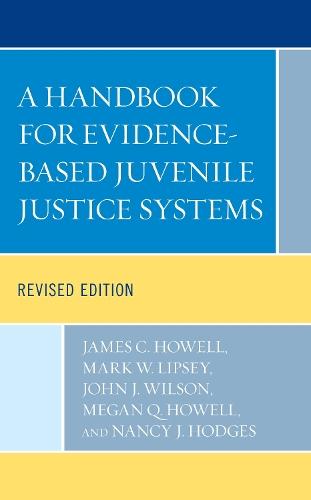
This revised edition features updated research, new developments in technology, and recent policy on juvenile delinquency and youth violence. The authors underscore the enormous payoff in targeting potential serious, violent, and chronic juvenile offenders at the earliest opportunity and provide a framework for evidence-informed state juvenile justice systems: the Comprehensive Strategy for Serious, Violent, and Chronic Juvenile Offenders. This strategy recognizes, first, that a relatively small proportion of those who enter the juvenile justice system will prove to be serious, violent, or chronic offenders, but that group accounts for a large proportion of overall delinquency. Second, this strategy builds on the fact that serious, violent, or chronic delinquency emerges along developmental pathways, allowing earlier identification of juveniles most at risk for later serious offending. A third component of this approach is effective intervention capable of reducing the recidivism of those juveniles most at risk for further delinquency. This framework emphasizes an evidence-based approach to reducing the recidivism of those juveniles most likely to reoffend from intake onward to probation, community programs, confinement, and reentry.
Full Product Details
Author: James C. Howell ,
Mark W. Lipsey ,
John J. Wilson ,
Megan Q. Howell
Publisher: Bloomsbury Publishing Plc
Imprint: Lexington Books
Edition: Revised edition
Dimensions:
Width: 16.10cm
, Height: 1.80cm
, Length: 22.90cm
Weight: 0.454kg
ISBN: 9781498595858
ISBN 10: 1498595855
Pages: 182
Publication Date: 18 September 2019
Audience:
Professional and scholarly
,
Professional & Vocational
Format: Hardback
Publisher's Status: Active
Availability: Manufactured on demand

We will order this item for you from a manufactured on demand supplier.
Reviews
It is a great pleasure for me to welcome this highly informative Handbook, which brilliantly combines comprehensive literature reviews with practical implications for juvenile justice policy. It describes a rational strategy for reducing juvenile offending based on (1) distinguishing serious, violent, and chronic offenders from others, (2) identifying key risk and protective factors for offending, (3) matching effective services to treatment needs, (4) applying graduated sanctions as the criminal career progresses, and (5) using effective interventions to reduce recidivism. It should be thoroughly read by everyone who is interested in understanding and reducing juvenile delinquency. -- David P. Farrington, Cambridge University, Emeritus Professor James C. Howell and colleagues have, once again, produced a comprehensive work that earns the name of Handbook. This volume is the essential companion and guide for every juvenile justice practitioner and policy maker. It is required reading for anyone seriously dedicated to this work, whether at the level of beginning student, to direct service provider, to chief administrator, to state policy maker. Properly used, it will become full of yellow highlights, margin notes and dog-eared pages, as is my copy of the first edition. -- Steven C. Hornsby, retired Judge and Former Deputy Commissioner, TN Division of Juvenile Justice
It is a great pleasure for me to welcome this highly informative Handbook, which brilliantly combines comprehensive literature reviews with practical implications for juvenile justice policy. It describes a rational strategy for reducing juvenile offending based on (1) distinguishing serious, violent, and chronic offenders from others, (2) identifying key risk and protective factors for offending, (3) matching effective services to treatment needs, (4) applying graduated sanctions as the criminal career progresses, and (5) using effective interventions to reduce recidivism. It should be thoroughly read by everyone who is interested in understanding and reducing juvenile delinquency. -- David P. Farrington, Cambridge University, Emeritus Professor James C. Howell and colleagues have, once again, produced a comprehensive work that earns the name of Handbook. This volume is the essential companion and guide for every juvenile justice practitioner and policy maker. It is required reading for anyone seriously dedicated to this work, whether at the level of beginning student, to direct service provider, to chief administrator, to state policy maker. Properly used, it will become full of yellow highlights, margin notes and dog-eared pages, as is my copy of the first edition. -- Steven C. Hornsby, retired Judge and Former Deputy Commissioner, TN Division of Juvenile Justice A Handbook for Evidence-based Juvenile Justice Systems, revised edition remains the quintessential text for researchers and practitioners alike with respect to strategies for juvenile justice reform. Howell and colleagues provide a comprehensive strategy, couched in empirical support, to provide the right services, to the right youth, at the right time, and include recommendations regarding the most pressing juvenile justice reforms. This is an essential text for juvenile justice administrators, policy makers, and those implementing or evaluating evidence-based programs. -- Michael Baglivio, PhD, Youth Opportunity Investments
It is a great pleasure for me to welcome this highly informative Handbook, which brilliantly combines comprehensive literature reviews with practical implications for juvenile justice policy. It describes a rational strategy for reducing juvenile offending based on (1) distinguishing serious, violent, and chronic offenders from others, (2) identifying key risk and protective factors for offending, (3) matching effective services to treatment needs, (4) applying graduated sanctions as the criminal career progresses, and (5) using effective interventions to reduce recidivism. It should be thoroughly read by everyone who is interested in understanding and reducing juvenile delinquency. -- David P. Farrington, Cambridge University, Emeritus Professor
Author Information
James C. Howell is senior research associate, National Gang Center, Institute for Intergovernmental Research. Mark W. Lipsey is research professor, Peabody Research Institute and Department of Human and Organizational Development, Peabody College, Vanderbilt University. John J. Wilson is senior research associate, Institute for Intergovernmental Research (IIR). Megan Q. Howell is contract administrator & data analyst, Department of Public Safety, DACJJ Juvenile Community Programs. Nancy J. Hodges is community program development specialist, North Carolina Department of Public Safety.