Overview
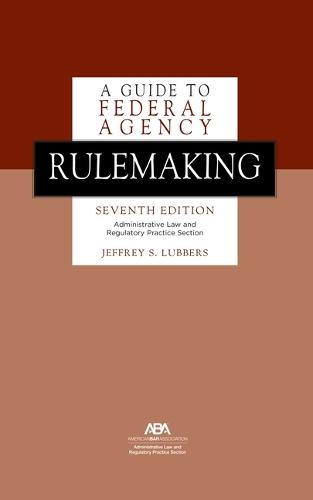
This seventh edition of A Guide to Federal Agency Rulemaking retains the basic organization of the previous six. Like its predecessors, this edition of the Guide has four parts. Part I is an overview of federal agency rulemaking and describes the major institutional ""players"" and the historical development of rulemaking. Part II describes the statutory framework of rulemaking, including the relevant sections of the APA and other statutes government-wide laws that have an impact on present-day rulemaking. Part III contains a step-by-step description of the informal rulemaking process, from the preliminary considerations to the final rule. Part IV discusses judicial review. Appendices include key rulemaking documents. This edition was written in a turbulent time for administrative law. The last three presidential transitions have been very sharp and sweeping. Key changes in this volume include updating the White House initiatives from Obama to Trump II in Part I and a new chapter on presidential transitions and rulemaking in Part III. The three judicial review chapters in Part IV have been extensively revised to consider the many transformative decisions of the Supreme Court concerning separation of powers, access to the courts to challenge agency regulations, and judicial review of agency legal interpretations (eliminating so-called Chevron deference and cutting back on Auer deference) and of agency fact finding and policy choice under the arbitrary-and-capricious test. The Court's development of the ""major questions doctrine,"" a judicial review canon that requires Congress to provide a clear statement authorizing major actions by agencies, is also critically examined. This book comes out at a time when deregulation is ascendant, and judicial challenges are proliferating. But the APA defines ""rulemaking"" to include ""formulating, amending or repealing"" rules, and the relevant judicial review doctrines are equally agnostic. Therefore, anyone on any side of these issues will benefit from this book.
Full Product Details
Author: Jeffrey S Lubbers
Publisher: American Bar Association
Imprint: American Bar Association
Edition: 7th ed.
ISBN: 9781639057368
ISBN 10: 1639057366
Pages: 858
Publication Date: 30 June 2026
Audience:
General/trade
,
General
Format: Paperback
Publisher's Status: Forthcoming
Availability: Not yet available

This item is yet to be released. You can pre-order this item and we will dispatch it to you upon its release.
Author Information
Jeffrey S. Lubbers was appointed Professor of Practice of Administrative Law at American University's Washington College of Law in 2009, after being a Fellow in Law and Government since 1996. He has also taught at the University of Miami School of Law, and has been a Visiting Professor at Washington and Lee University School of Law, the Georgetown University Law Center, and several overseas law schools. He has an A.B. degree from Cornell University and a J.D. from the University of Chicago Law School. Prior to joining American University, he served in various positions with the Administrative Conference of the United States (ACUS), the U.S. Government's advisory agency on procedural improvements in federal programs until its closure by the 104th Congress in 1995. From 1982-1995 he was ACUS' Research Director--a position in the Senior Executive Service. Upon its reopening in 2010, he was appointed as a Special Counsel. He served as Team Leader for Vice President Gore's National Performance Review team on Improving Regulatory Systems in 1993. He is the author of the ABA's Guide to Federal Agency Rulemaking (6th ed. 2018), has co-authored the Administrative Procedure Sourcebook (5th ed. 2016), and served as the editor for the ABA's annual Developments in Administrative Law and Regulatory Practice (16 volumes from 1998-2014). He is also the co-author of Administrative Law and Process in a Nutshell (7th ed. 2025). In addition to his teaching, he has served as a consultant to various federal agencies and non-profits, including the ABA, the World Bank, the USAID, the OECD, the Asia Foundation, and the Yale University China Law Center.