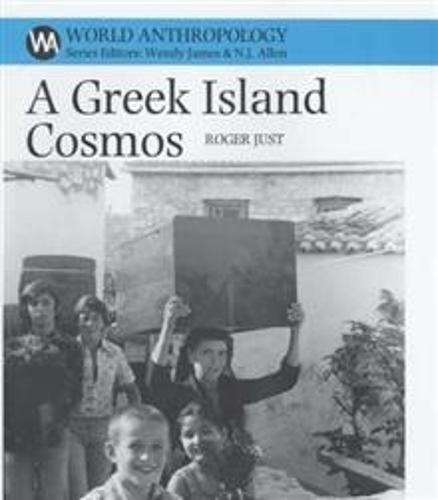
Full Product Details
Author: Roger Just
Publisher: James Currey
Imprint: James Currey
Dimensions:
Width: 15.60cm
, Height: 2.70cm
, Length: 23.40cm
Weight: 0.588kg
ISBN: 9780852552674
ISBN 10: 085255267
Pages: 288
Publication Date: 01 January 2000
Audience:
College/higher education
,
Professional and scholarly
,
Undergraduate
,
Postgraduate, Research & Scholarly
Format: Hardback
Publisher's Status: Active
Availability: In Print

This item will be ordered in for you from one of our suppliers. Upon receipt, we will promptly dispatch it out to you. For in store availability, please contact us.
Reviews
'Roger Just has a very perceptive ethnographic eye (and ear) and is extremely skilful at unravelling often seemingly mundane events in a manner that is illuminating, sympathetic and often witty. His descriptions of island life are evocative and manage to be sensitive to attractions without falling into romanticism.' - Sharon MacDonald, University of Sheffield '... contains an extremely thorough examination of the nuts and bolts of consanguinity, affinity and godparenthood, but Just was also very much a participating observer, working as a fisherman's mate, and as dish-washer and helper to the gregarious Nikos in his coffee shop. Some of the book's livelier passages are descriptions of incidents which involved him trying to balance his good relations with everyone in a tight-knit, gossipy community. He describes sleepless nights spent planning routes and manoeuvres by which he could accept the gift of olive oil from a person (it being deemed inappropriate to buy it) without anyone else learning about it and being offended that the gift was not from them. Creeping down side streets with oily newspaper-wrapped bottles concealed under my coat , he wonders How could anything so simple have become so complicated? ' - Sofka Zinovieff in The Times Literary Supplement '... in sum, a fine piece of work from start to finish. Just's scholarship in plumbing the history of Meganisi, including the alternative etymologies of local toponymy, matches his powers of ethnographic observation and give this book an overall balance. Central topics of discussion such as dowry, gender relations and privacy are all cross-referenced with the treatments given by other anthropologists of Greece, thus making this book a valuable key to the whole of Greek ethnography.' - Charles Stewart in The Anglo-Hellenic Review 'His defence of the rural community as a viable unit of analysis is very stimulating and constitutes an excellent reading for courses examining anthropological methodology and the anthropology of Europe. ...This scholarly and well-written monograph is a testimony to the value of careful anthropological research and will inevitably expand the anthropological appreciation of ethnographic diversity within Greece.' - Dimitrios Theodossopoulos in the JRAI 'A monograph whose central topics are kinship, ritual relationships (wedding-sponsorship and god-parenthood), cross-cutting ties of kinship and neighbourhood, household and inheritance, and marriage and dowry, could well have been written in a vein of post-modern irony. These topics were once considered the bedrock of the anthropological enterprise and then subjected to critical discussion, redefinition, and deconstruction. Just's reasons for writing the book as he has done are convincingly given in terms which would satisfy both the most stolid advocate of the standard monograph and the trendiest of reflexive post-modernists. Initially intending to study what seemed to be immediately relevant issues of politics, economics, class and conflict, he found that he could not get a grip on these without first understanding family and kinship relations. '...The reader is brought into the experience of fieldwork, and of the development of theorizing, through examples of his misconceptions, errors and growing realizations of how things might fit together. The views of local people are also foregrounded and integrated into the discussion; their life-stories and personalities are vividly presented.' - Margaret Kenna in South European Society & Politics 'This is a vivid, affectionate and often humorous account of a people and a place at a specific time in their history, and it is a valuable contribution to the ethnography of kinship in the twentieth-century Greece and Southern Europe...an ethnographically rich, historically sensitive and evocative study...' - Paola Filippucci in Ethnos 'His defence of the rural community as a viable unit of analysis is very stimulating and constitutes an excellent reading for courses examining anthropological methodology and the anthropology of Europe. ...This scholarly and well-written monograph is a testimony to the value of careful anthropological research and will inevitably expand the anthropological appreciation of ethnographic diversity within Greece.' - Dimitrios Theodossopoulos in the JRAI 'A monograph whose central topics are kinship, ritual relationships (wedding-sponsorship and god-parenthood), cross-cutting ties of kinship and neighbourhood, household and inheritance, and marriage and dowry, could well have been written in a vein of post-modern irony. These topics were once considered the bedrock of the anthropological enterprise and then subjected to critical discussion, redefinition, and deconstruction. Just's reasons for writing the book as he has done are convincingly given in terms which would satisfy both the most stolid advocate of the standard monograph and the trendiest of reflexive post-modernists. Initially intending to study what seemed to be immediately relevant issues of politics, economics, class and conflict, he found that he could not get a grip on these without first understanding family and kinship relations. '...The reader is brought into the experience of fieldwork, and of the development of theorizing, through examples of his misconceptions, errors and growing realizations of how things might fit together. The views of local people are also foregrounded and integrated into the discussion; their life-stories and personalities are vividly presented.' - Margaret Kenna in South European Society & Politics 'This is a vivid, affectionate and often humorous account of a people and a place at a specific time in their history, and it is a valuable contribution to the ethnography of kinship in the twentieth-century Greece and Southern Europe...an ethnographically rich, historically sensitive and evocative study...' - Paola Filippucci in Ethnos 'As Just defines it, community is not a function of a uniform cultural mentality or geographical isolation but an idea that people have about themselves as people who share particular values. His book traces a compelling story of how this works out in practice, how the rhetoric in part constitutes social life, how different rhetorics of identity compete. ...Just is, arguably, a classic social anthropologist whose questions are solidarity not classically structural-functionalist. Fundamentally, he wants to know what the effects are on social reality of what people say they believe.
... an ambitious and successful attempt to reinvigorate the anthropological study of kinship and community. - Shauna LaTosky in ANTHROPOLOGICA Roger Just has a very perceptive ethnographic eye (and ear) and is extremely skilful at unravelling often seemingly mundane events in a manner that is illuminating, sympathetic and often witty. His descriptions of island life are evocative and manage to be sensitive to attractions without falling into romanticism. - Sharon MacDonald, University of Sheffield ... contains an extremely thorough examination of the nuts and bolts of consanguinity, affinity and godparenthood, but Just was also very much a participating observer, working as a fisherman's mate, and as dish-washer and helper to the gregarious Nikos in his coffee shop. Some of the book's livelier passages are descriptions of incidents which involved him trying to balance his good relations with everyone in a tight-knit, gossipy community. He describes sleepless nights spent planning routes and manoeuvres by which he could accept the gift of olive oil from a person (it being deemed inappropriate to buy it) without anyone else learning about it and being offended that the gift was not from them. Creeping down side streets with oily newspaper-wrapped bottles concealed under his coat, he wonders 'How could anything so simple have become so complicated?' - Sofka Zinovieff in THE TIMES LITERARY SUPPLEMENT ... in sum, a fine piece of work from start to finish. Just's scholarship in plumbing the history of Meganisi, including the alternative etymologies of local toponymy, matches his powers of ethnographic observation and give this book an overall balance. Central topics of discussion such as dowry, gender relations and privacy are all cross-referenced with the treatments given by other anthropologists of Greece, thus making this book a valuable key to the whole of Greek ethnography. - Charles Stewart in THE ANGLO-HELLENIC REVIEW His defence of the rural community as a viable unit of analysis is very stimulating and constitutes an excellent reading for courses examining anthropological methodology and the anthropology of Europe. ...This scholarly and well-written monograph is a testimony to the value of careful anthropological research and will ineviell-written monograph is a testimony to the value of careful anthropological research and will inevitably expand the anthropologic