Overview
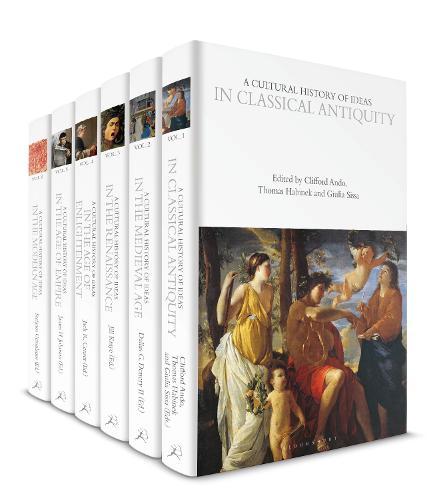
How has the nature of ideas evolved over time? How have ideas been shaped, employed and received in different social and cultural contexts? In a work that spans 2,800 years, these ambitious questions are addressed by 62 experts, each contributing an overview of a particular theme in a specific period in history. The volumes explore the development of ideas , primarily in the West, from a range of disciplinary angles. Individual volume editors ensure the cohesion of the whole and, for ease of navigation, chapter titles are identical across each of the volumes. This schema offers the reader the choice of reading about a specific period in one of the volumes or following one theme across history by reading the relevant chapter in each of the 6. The 6 volumes cover: 1. - Classical Antiquity (800 BCE - 500 CE); 2. - Medieval Age (500 - 1450); 3. - Renaissance (1450 - 1650) ; 4. - Age of Enlightenment (1650 - 1800); 5. - Age of Empire (1800 - 1920); 6. - Modern Age (1920 - 2000+). Themes (and chapter titles) are: Knowledge; The Human Self; Ethics and Social Relations; Politics and Economies; Nature; Religion and the Divine; Language, Poetry and Rhetoric; The Arts; History. The page extent is approximately 1,728pp with c. 240 illustrations. Each volume opens with Notes on Contributors, Series Preface and Introduction, and concludes with Notes, Bibliography and an Index.
Full Product Details
Author: Professor Sophia Rosenfeld (University of Pennsylvania, USA) ,
Professor Peter T. Struck (University of Pennsylvania, USA)
Publisher: Bloomsbury Publishing PLC
Imprint: Bloomsbury Academic
ISBN: 9781350007550
ISBN 10: 1350007552
Publication Date: 17 November 2022
Audience:
Professional and scholarly
,
Professional & Vocational
Format: Mixed media product
Publisher's Status: Active
Availability: To order

Stock availability from the supplier is unknown. We will order it for you and ship this item to you once it is received by us.
Author Information
Sophia Rosenfeld is Walter H. Annenberg Professor of History at the University of Pennsylvania, USA. She is the author of A Revolution in Language: The Politics of Signs in Eighteenth-Century France (2001); Common Sense: A Political History (2011), which won the Mark Lynton History Prize and the Society for Historians of the Early American Republic Book Prize; and Democracy and Truth: A Short History (2019). Peter T. Struck is Professor of Classical Studies at the University of Pennsylvania, USA. He is the author of Birth of the Symbol: Ancient Readers at the Limits of Their Texts (2004); and Divination and Human Nature: A Cognitive History of Intuition in Antiquity (2016). Both won the Goodwin Award for best book in Classical Studies. He is co-editor, with Rita Copeland, of The Cambridge Companion to Allegory (2010).