|
|
|||
|
||||
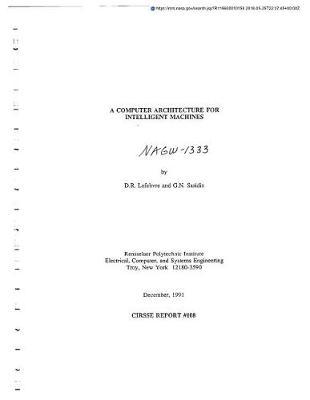
OverviewThe Theory of Intelligent Machines proposes a hierarchical organization for the functions of an autonomous robot based on the Principle of Increasing Precision With Decreasing Intelligence. An analytic formulation of this theory using information-theoretic measures of uncertainty for each level of the intelligent machine has been developed in recent years. A computer architecture that implements the lower two levels of the intelligent machine is presented. The architecture supports an event-driven programming paradigm that is independent of the underlying computer architecture and operating system. Details of Execution Level controllers for motion and vision systems are addressed, as well as the Petri net transducer software used to implement Coordination Level functions. Extensions to UNIX and VxWorks operating systems which enable the development of a heterogeneous, distributed application are described. A case study illustrates how this computer architecture integrates real-time and higher-level control of manipulator and vision systems. Lefebvre, D. R. and Saridis, G. N. Unspecified Center NASA-CR-191861, NAS 1.26:191861, RPI-CIRSSE-108 NAGW-1333... Full Product DetailsAuthor: National Aeronaut Administration (Nasa)Publisher: Createspace Independent Publishing Platform Imprint: Createspace Independent Publishing Platform Dimensions: Width: 21.60cm , Height: 0.20cm , Length: 28.00cm Weight: 0.106kg ISBN: 9781724983923ISBN 10: 172498392 Pages: 34 Publication Date: 09 August 2018 Audience: General/trade , General Format: Paperback Publisher's Status: Active Availability: Available To Order We have confirmation that this item is in stock with the supplier. It will be ordered in for you and dispatched immediately. Table of ContentsReviewsAuthor InformationTab Content 6Author Website:Countries AvailableAll regions |
||||