Overview
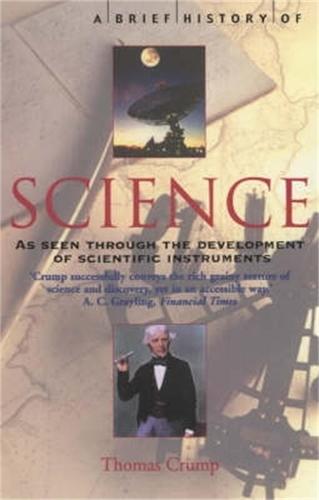
From earliest pre-history, with the dawning understanding of fire and its many uses, up to the astonishing advances of the twenty-first century, Thomas Crump traces the ever more sophisticated means employed in our attempts to understand the universe. The result is a vigorous and readable account of how our curious nature has continually pushed forward the frontiers of science and, as a consequence, human civilization.
Full Product Details
Author: Thomas Crump
Publisher: Little, Brown Book Group
Imprint: Robinson Publishing
Dimensions:
Width: 20.10cm
, Height: 3.10cm
, Length: 13.20cm
Weight: 0.326kg
ISBN: 9781841195520
ISBN 10: 1841195529
Pages: 464
Publication Date: 26 September 2002
Audience:
General/trade
,
General
Format: Paperback
Publisher's Status: Active
Availability: Manufactured on demand

We will order this item for you from a manufactured on demand supplier.
Reviews
'Crump successfully conveys the rich grainy texture of science and discovery, yet in an accessible way... [This] is a serious and fully furnished history of science, from which anyone interested in the development of ideas - or indeed, in history itself - will greatly profit.' - A.C. Grayling, Financial Times; 'He provides lively summaries of the progress in different fields, and succeeds in breathing new life into familiar stories.' - Economist
There have been many histories of Western science, but Crump's take is an original one: to look at the part played by scientific instruments in the development of science. As Crump points out, without instruments that enable us to measure the world around us most scientific ideas are merely speculation. For most of human history, people's ability to understand the world was limited by two things: the fact that they never ventured outside their immediate locale, and so didn't become aware of the variety that exists in other parts of the world; and the fact that they experienced the world only through their five senses, and so could have no knowledge of anything they couldn't see with the naked eye. This didn't stop people trying to understand the way the world works, but it did mean they were often badly mistaken. Thus it was that Aristotle's explanation of the way the world works, with his insistence that the earth was at the centre of the universe and all matter was composed of four basic elements, held sway for 1500 years. The two most significant instruments that changed the course of scientific progress, says Crump, were the telescope and the microscope. The first made the science of astronomy possible; the second opened the way to the study of microbiology and atomic physics. Crump concentrates mainly on the physical sciences - chemistry, physics and astronomy - and takes in the major figures, such as Copernicus, Newton, Galileo and, more recently, Einstein and Rutherford. Of necessity, the book's focus is skewed towards developments in the last couple of hundred years, with the last chapters tackling the increasingly complex area of what Crump calls 'big science': quantum mechanics and the study of subatomic particles, a study made possible by the astonishingly powerful and precise nature of modern scientific instruments. The whole study is engagingly written: Crump knows how to make his subject come alive. He's good both at showing the human stories behind many scientific developments, and at explaining the science itself, even the very difficult science of the later chapters. At the same time, he never talks down to the reader. It's an excellent overview of the subject, and will be enjoyed equally by scientists and non-scientists alike. (Kirkus UK)
Author Information
Thomas Crump was the author of A Brief History of Science. His lifelong passionate interest in science and its history gave rise to a number of books, including Solar Eclipse and The Anthropology of Numbers. A mathematician and anthropologist, until his retirement in 1994, he taught anthropology at the University of Amsterdam.