|
|
|||
|
||||
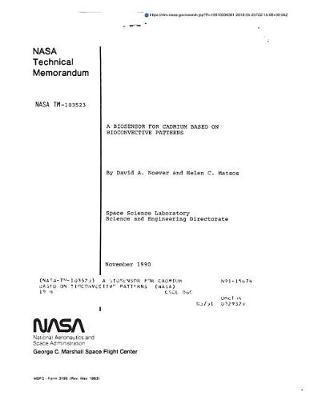
OverviewAn 'in vitro' method for monitoring cadmium, one of the most lethal bivalent heavy metals, can detect biologically active levels. The effects of cadmium tend to concentrate in protozoa far above natural levels and therein begin transferring through freshwater food chains to animals and humans. In a small sample volume (approximately 5 ml) the method uses the toxic response to the protozoa, Tetrahymena pyriformis, to cadmium. The assay relies on macroscopic bioconvective patterns to measure the toxic response, giving a sensitivity better than 1 micro-g/1 and a toxicity threshold to 7 micro-g/1 for Cd(2+). Cadmium hinders pattern formation in a dose-dependent manner. Arrested organism growth arises from slowed division and mutation to non-dividing classes. Unlike previous efforts, this method can be performed in a shallow flow device and does not require electronic or chemical analyses to monitor toxicity. Noever, David A. and Matsos, Helen C. Marshall Space Flight Center NASA-TM-103523, NAS 1.15:103523 ... Full Product DetailsAuthor: National Aeronaut Administration (Nasa)Publisher: Createspace Independent Publishing Platform Imprint: Createspace Independent Publishing Platform Dimensions: Width: 21.60cm , Height: 0.20cm , Length: 28.00cm Weight: 0.115kg ISBN: 9781724974594ISBN 10: 1724974599 Pages: 38 Publication Date: 09 August 2018 Audience: General/trade , General Format: Paperback Publisher's Status: Active Availability: Available To Order We have confirmation that this item is in stock with the supplier. It will be ordered in for you and dispatched immediately. Table of ContentsReviewsAuthor InformationTab Content 6Author Website:Countries AvailableAll regions |
||||