Overview
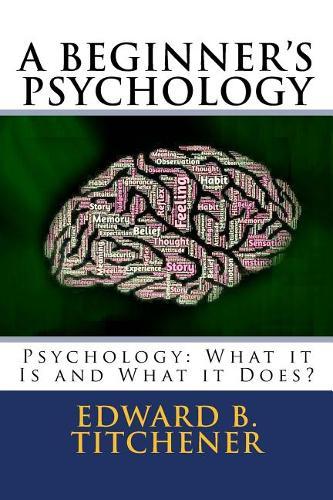
It is an acknowledged fact that we perceive errors in the work of others more readily than in our own. -Leonardo da Vinci In this Beginner's Psychology I have tried to write, as nearly as might be, the kind of book that I should have found useful when I was beginning my own study of psychology. That was nearly thirty years ago; and I read Bain, and the Mills, and Spencer, and Rabier, and as much of Wundt as a struggling acquaintance with German would allow. Curiously enough, it was a paragraph in James Mill, most unpsychological of psychologists, that set me on the introspective track, -though many years had to pass before I properly understood what had put him off it. A book like this would have saved me a great deal of labour and vexation of spirit. Nowadays, of course, there are many introductions to psychology, and the beginner has a whole library of text-books to choose from. Still, they are of varying merit; and, what is perhaps more important, their temperamental appeal is diverse. I do not find it easy to relate this new book to the older Primer, -which will not be further revised. There is change all through; every paragraph has been rewritten. The greatest change is, however, a shift of attitude; I now lay less stress than I did upon knowledge and more upon point of view. The beginner in any science is oppressed and sometimes disheartened by the amount he has to learn; so many men have written, and so many are writing; the books say such different things, and the magazine articles are so upsetting!
Full Product Details
Author: Edward Bradford Titchener
Publisher: Createspace Independent Publishing Platform
Imprint: Createspace Independent Publishing Platform
Dimensions:
Width: 15.20cm
, Height: 1.50cm
, Length: 22.90cm
Weight: 0.404kg
ISBN: 9781717332691
ISBN 10: 1717332692
Pages: 272
Publication Date: 23 April 2018
Audience:
General/trade
,
General
Format: Paperback
Publisher's Status: Active
Availability: Available To Order

We have confirmation that this item is in stock with the supplier. It will be ordered in for you and dispatched immediately.
Author Information
Edward Bradford Titchener was born on January 11, 1867 in Chichester, England and attended Malvern College on a scholarship. While his family originally intended for him to enter the clergy, Titchener's interests were elsewhere. In 1885, he began studying at Oxford. He initially focused on biology, but he soon shifted to the study of comparative psychology. During his time at Oxford, he began to read the writings of Wilhelm Wundt and later translated the first volume of Wundt's famous text Principles of Physiological Psychology from German into English. Titchener graduated from Oxford in 1890 and then began studying with Wundt in Leipzig, Germany. He went on to earn his Ph.D. in Psychology from the University of Leipzig in 1892. Career: After earning his Ph.D., Titchener took a position as a professor of psychology at Cornell University in Ithaca, New York. It was here that he established the psychological school of thought known as structuralism. Titchener believed that by systematically defining and categorizing the elements of the mind, researchers could understand the structure of the mental processes. While he is often described as an apostle of Wundt's, Titchener's ideas differed from those of his mentor. He utilized Wundt's method of introspection but under much more stringent guidelines. He was only interested in things that existed in the consciousness, so things such as instincts or the unconscious were of no interest to him. Introspection was a technique that relies on self-observation. Trained observers were presented with different objects or events and then asked to describe the mental processes they experienced. Based on this kind of research, Titchener concluded that there three essential elements that made up all conscious experiences: feelings, sensations, and images.