Overview
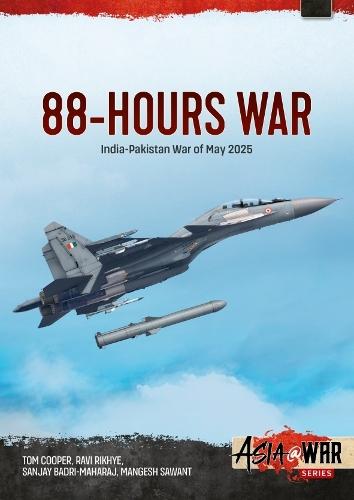
Much downplayed, even ignored, short but sharp military confrontation between India and Pakistan, fought in the course of less than four days of May 2025 was an affair that saw the deployment of some of most advanced weapons systems currently in operation. Widely mis-declared into a mere continuation of the Kashmir Conflict, a 'large-scale cross-border skirmish', a 'drone battle' that ended with both sides announcing a ceasefire and a victory, 'actually' ending when the administration of US President Donald Trump played a deal-broker, a peace-maker, and saviour of both Asian nations, it is going to determine relations between the two nuclear powers for decades in advance. On 22 April 2025, a terrorist attack outside Pahalgam in Indian-administered Jammu and Kashmir killed 26 civilians, mostly Hindu tourists. A Pakistan-based, UN-designated terrorist group first claimed responsibility, then denied involvement, while official Islamabad which plotted this affair with the aim of drawing world-wide attention to the Kashmir issue declared the massacre a 'false flag operation' orchestrated by India. The government in New Delhi reacted by retaliatory measures before, after finding undisputable evidence about Pakistan's involvement, early on 7 May 2025, launching a series of retaliatory strikes on camps of multiple terror organisations. Insistent on dictating India's foreign policy, on preventing such counter-strikes through threats with deployment of nuclear weapons, and mythology about invincibility of its armed services, Islamabad then miscalculated: it launched attacks against civilian-, military-, and religious objects in Indian-administered Jammu, using mortars, artillery rockets and unmanned aerial vehicles (UAVs). Much to Pakistan's surprise, India reacted by launching a carefully orchestrated, measured operation against Pakistani air defences. Over the following two days, Pakistan continued escalating its 'drone war'. However, the mass of its weaponry was shot down, rendering its retaliation entirely ineffective. At that point, Islamabad ordered ballistic missile attacks on 26 targets in India. New Delhi reacted with a devastating missile strike that, in matter of 90 minutes, disabled multiple major command centres, blocked the runways on several PAF air bases, and demolished hangars housing some of most important aircraft of its opponent. As a cup on cake, India completed its methodical onslaught by targeting at least one, possibly two underground nuclear weapons storage facilities, clearly demonstrating its superior position. While certainly fuelled by the conflict over Kashmir, the India-Pakistan War of May 2025 was much more, and its outcome is going to dictate the relations between two nuclear powers for decades in advance. For the first time in 80-years-long history of enmity between the two nations, India not only dared to openly strike back at Pakistan in reaction to a terror attack the latter has instigated, but called its persistent threats with nuclear retaliation a bluff, neutralised the country's air defences and ability to retaliate, forced the PAF away from the international border thus bringing the IAF into a position to strike selected targets, and forced Islamabad to request an end to hostilities. Although Pakistani government skilfully supported by Chinese propaganda warfare, and usual Western favouritism and ignorance successfully covered-up the extension of its defeat, even declared itself for victorious, relations between the two countries are never going to be the same again. Richly illustrated by custom-drawn diagrams and colour profiles, the book 88-Hours War is providing full backgrounds and context to this little-understood conflict, a detailed description of the involved technology, and a blow-by-blow account of the fighting from 7 to 10 May 2025. As such, it is an indispensable source of reference for both professionals and enthusiasts alike. 90 colour illustrations, 60 colour photos, 30 colour profiles, 10 colour maps, 6 tables
Full Product Details
Author: Tom Cooper ,
Ravi Rikhye ,
Sanjay Badri-Maharaj ,
Mangesh Sawant
Publisher: Helion & Company
Imprint: Helion & Company
ISBN: 9781806720859
ISBN 10: 180672085
Pages: 88
Publication Date: 15 January 2026
Audience:
Adult education
,
Further / Higher Education
Format: Paperback
Publisher's Status: Forthcoming
Availability: Not yet available

This item is yet to be released. You can pre-order this item and we will dispatch it to you upon its release.
Author Information
Tom Cooper is an Austrian aerial warfare analyst and historian. Following a career in worldwide transportation business – during which he established a network of contacts in the Middle East and Africa – he moved into narrow-focus analysis and writing on small, little-known air forces and conflicts, about which he has collected extensive archives. This has resulted in specialization in such Middle Eastern air forces as of those of Egypt, Iran, Iraq, and Syria, plus various African and Asian air forces. Except for authoring and co-authoring more than 30 books - including about a dozen of titles for Helion’s @War series - and over 1000 articles, Cooper is a regular correspondent for multiple defense-related publications. Ravi Rikhye studied international military affairs for 10-years before writing his first paper. Over the last 60 years he has authored and co-authored over 30 books, many of these for the Government of India. He is currently completing his seventh master's degree (in Intelligence Management), and hoping to undetake his first doctorate. Sanjay Badri-Maharaj from Trinidad, received his MA and PhD from the Department of War Studies, Kings College London. His thesis was on India’s Nuclear Weapons Program. He has written and published extensively, including two books – The Armageddon Factor: Nuclear Weapons in the India-Pakistan Context (2000) and Indian Nuclear Strategy: Confronting the Potential Nuclear Threat from both Pakistan and China (2018). He has served as a consultant to the Ministry of National Security in Trinidad and was a visiting International Fellow at the Institute for Defence Studies and Analyses, New Delhi. This is his first instalment for Helion. Mangesh Sawant has two Masters’ Degrees, one in International Affairs from Columbia University, New York where he concentrated on international security policy, the other in Political Science from the University of Mumbai. Mangesh is a scholar practitioner with over 20 years of international experience and expertise in the fields of international security and military studies. He is an expert on the Chinese military (PLA, PLAN, PLAAF and PLARF) with a focus on weapon systems, organisation, culture, warfighting capabilities and strategy and tactics. His articles relating to the Chinese military, geopolitical risks and warfare have been published in international security and military journals.