|
|
|||
|
||||
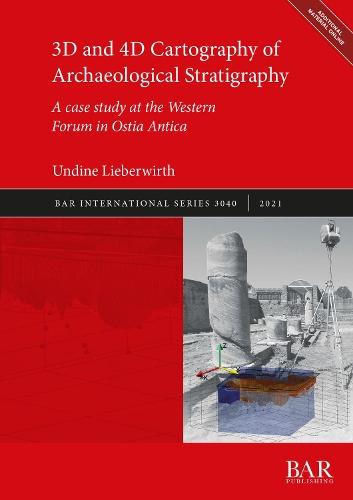
OverviewFull Product DetailsAuthor: Undine LieberwirthPublisher: BAR Publishing Imprint: BAR Publishing Weight: 0.463kg ISBN: 9781407357867ISBN 10: 1407357867 Pages: 116 Publication Date: 31 August 2021 Audience: Professional and scholarly , Professional & Vocational Format: Paperback Publisher's Status: Active Availability: Available To Order We have confirmation that this item is in stock with the supplier. It will be ordered in for you and dispatched immediately. Table of ContentsList of Figures List of Tables Foreword 1. Introduction 1.1 3D cartography in archaeology 1.1.1 GIS & space in archaeology. 1.1.2 3D models in 3D space 1.2 Conceptual design & operational framework 1.2.1 Data analysis - a methodological & archaeological approach 1.2.2 Data modelling - a methodological approach 1.2.3 Data acquistion - an archaeological & methodological approach 1.3 Structure of this book 1.3.1 Chapter 1: Introduction 1.3.2 Chapter 2: 3D data acquisition 1.3.3 Chapter 3: 3D data modelling 1.3.4 Chapter 4: 3D data analysis 1.3.5 Chapter 5: Discussion & conclusion 2. 3D Data Acquisition 2.1 Experimental setup & workflow 2.1.1 Archaeological background 2.1.2 Practical implementation 2.2 Documentation on-site 2.2.1 Geophysical data acquisition 2.2.2 Archaeological data acquisition 2.2.3 Pedological data acquisition 2.3 Documentation off-site 2.3.1 Data management & storage 2.3.2 Pedological laboratory analysis 3. 3D Data Modelling 3.1 Geophysical data modelling 3.2 Archaeological data modelling 3.3 Pedological data modelling 4. 3D Data Analysis 4.1 Technical analysis 4.2 Archaeological analysis 4.2.1 Analysis: geophysics & archaeology 4.2.2 Analysis: archaeology 4.2.3 Analysis: pedology & archaeology 4.3 Experiments 4.3.1 Colour test 4.3.2 SfM post-processing - Agisoft PhotoScan® versus VSFM versus BundlerTools 5. Discussion & Conclusion 5.1 Discourse: 3D data acquisition 5.1.1 Geophysical prospection - WS i) 5.1.2 Surface documentation - WS ii, vi, vii) 5.1.3 Excavation - WS iii) 5.1.4 Soil sampling & documentation - WS iv, x) 5.1.5 Feature & find documentation - WS v) 5.1.6 TLS - WS vi) 5.1.7 SfM - WS vii) 5.1.8 Photogrammetry - WS viii) 5.1.9 Archaeological documentation - WS ix) 5.1.10 3D point cloud processing - WS xi, xiii) 5.1.11 3D point cloud creation - WS xii, xiv) 5.1.12 Orthorectification - WS xv) 5.1.13 Archaeological & pedological data processing - WS xvi, xvii) 5.1.14 Chemical analysis - WS xviii) 5.1.15 Summary of discourse: 3D data acquisition 5.2 Discourse: 3D data modelling 5.2.1 Geophysical model transformation - WS xix) 5.2.2 Model building of layers - WS xx, xxi) 5.2.3 Generation of orthophotos - WS xxii) 5.2.4 Conversion of 3D vector points & 3D polylines - WS xxiii) 5.2.5 Calculation of 3D distribution of chemical elements in soil samples - WS xxiv-xxv) 5.2.6 Summary of discourse: 3D data modelling 5.3 Discourse: 3D data analysis & visualisation 5.3.1 Visualisation i, ii - AN i, ii + WS xxvi) 5.3.2 Voxel volume versus interpolation, 3D polyline, raster surface - AN iii, iv-vii) 5.3.3 Voxel volume versus interpolation, 3D polyline, raster surface, DB-link - AN viii-x) 5.3.4 Geochemistry: calcium - AN xi-xiv) 5.3.5 Experiment: colour test 5.3.6 Experiment: SfM processing 5.3.7 Summary of discourse: 3D data analysis 5.4 Summary: theoretical concepts & practical implementation ReferencesReviews'The 3D documentation of every layer in a single context excavation is highly unusual, having only been attempted a few times. Although the workflow is very complicated, this has the potential to be a visualisation/analytical game changer.' Dr James Taylor, University of York 'We are still at the beginning of true 3D-documentation of archaeological excavations. Recent advancement in technology is opening new possibilities for 3D-documentation of archaeological sites, and this work comes at a very good time. It will be of great interest for other researchers.' Espen Uleberg, Museum of Cultural History, University of Oslo Author InformationUndine Lieberwirth studied Prehistoric and Classical Archaeology and specialised in Geographic Information Systems (GIS) with Geospatial Databases. Her scientific interests lie in researching efficient and sustainable applications of the Digital Humanities in Ancient Studies. A particular focus is on three-dimensional data acquisition, modelling and analysis. She has been experimenting with voxel depiction of archaeological stratigraphy in GIS since 2007. To achieve reliable results, she specialized in 3D digital documentation methods such as laser scanning, became a drone pilot and learned and taught the processing of UAV (unmanned aerial vehicle)-data using the Structure from Motion method. Tab Content 6Author Website:Countries AvailableAll regions |
||||