|
|
|||
|
||||
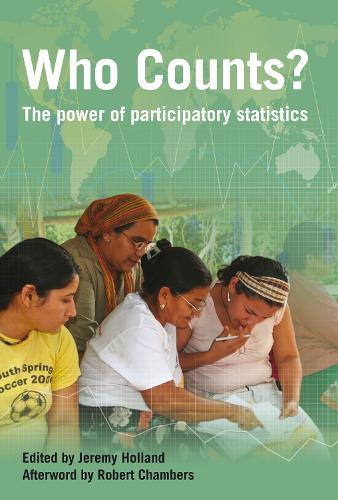
OverviewLocal people can generate their own numbers and the statistics that result are powerful for themselves and can influence policy. Development practitioners are supporting and facilitating participatory statistics from community-level planning right up to sector and national-level policy processes. Statistics are being generated in the design, monitoring and evaluation, and impact assessment of development interventions.Through describing policy, programme and project research, Who Counts? provides impetus for a step change in the adoption and mainstreaming of participatory statistics within international development practice. The challenge laid down is to foster institutional change on the back of the methodological breakthroughs and philosophical commitment described in this book. The prize is a win-win outcome in which statistics are a part of an empowering process for local people and part of a real-time information flow for those aid agencies and government departments willing to generate statistics in new ways. Full Product DetailsAuthor: Jeremy HollandPublisher: Practical Action Publishing Imprint: Practical Action Publishing Dimensions: Width: 15.60cm , Height: 1.70cm , Length: 23.40cm Weight: 0.464kg ISBN: 9781853397714ISBN 10: 1853397717 Pages: 224 Publication Date: 15 April 2013 Audience: Professional and scholarly , Professional & Vocational Format: Hardback Publisher's Status: Active Availability: Available To Order We have confirmation that this item is in stock with the supplier. It will be ordered in for you and dispatched immediately. Table of Contents1 Introduction Participatory statistics: a 'win-win' for international development Jeremy Holland PART I Participatory statistics and policy change 2 Participatory 3-dimensional modelling for policy and planning: the practice and the potential Giacomo Rambaldi 3 Measuring urban adaptation to climate change: experiences in Kenya and Nicaragua Caroline Moser and Alfredo Stein 4 Participatory statistics, local decision-making, and national policy design: Ubudehe community planning in Rwanda Ashish Shah 5 Generating numbers with local governments for decentralized health sector policy and planning in the Philippines Rose Marie R. Nierras 6 From fragility to resilience: the role of participatory community mapping, knowledge management, and strategic planning in Sudan Margunn Indreboe Alshaikh Part II Who counts reality? Participatory statistics in monitoring and evaluation 7 Accountability downwards, count-ability upwards: quantifying empowerment outcomes from people's own analysis in Bangladesh Dee Jupp with Sohel Ibn Ali 8 Community groups monitoring their impact with participatory statistics in India: reflections from an international NGO Collective Bernward Causemann, Eberhard Gohl, C. Rajathi, A. Susairaj, Ganesh Tantry and Srividhya Tantry 9 Scoring perceptions of services in the Maldives: instant feedback and the power of increased local engagement Nils Riemenschneider, Valentina Barca, and Jeremy Holland 10 Are we targeting the poor? Lessons with participatory statistics in Malawi Carlos Barahona PART III Statistics for participatory impact assessment 11 Participatory impact assessment in drought policy contexts: lessons from southern Ethiopia Dawit Abebe and Andy Catley 12 Participatory impact assessment: the 'Starter Pack Scheme' and sustainable agriculture in Malawi Elizabeth Cromwell, Patrick Kambewa, Richard Mwanza, and Rowland Chirwa with KWERA Development Centre 13 Participatory impact assessments of farmer productivity programmes in Africa Susanne Neubert Afterword Robert Chambers Practical and accessible resources IndexReviewsAuthor InformationJeremy Holland is Lecturer at the Centre for Development Studies at the University of Wales Swansea and Visiting Lecturer at the Institute for Development Studies, University of Sussex Tab Content 6Author Website:Countries AvailableAll regions |
||||