Overview
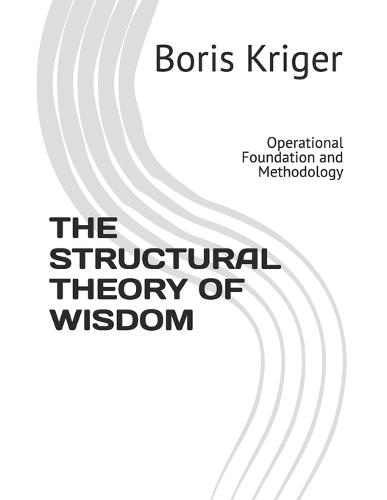
This volume develops a structural theory of the operation classical traditions have called Wisdom, defining it as the precise capacity to change the frame within which a problem is posed when the frame admits no resolution. The framework gives this operation an algebra under three independent structural operations - orthogonal displacement, volumetric duality, and topological duality - and proves, as its principal corollary, that genuine general intelligence is structurally incompatible with malicious action. The work supplies the philosophical foundation for AI safety that the field currently lacks: safety is not a constraint upon capability but a structural property of the operations that constitute it. The question of how artificial systems might be made safe at the threshold of general intelligence has, to date, proceeded without a formal account of what makes any system unsafe. The prevailing paradigm treats capability and disposition as orthogonal - assuming any level of intelligence is compatible with any goal, including destructive ones - and proceeds by imposing external constraint upon the system. This volume argues that the assumption is structurally false, and that the corresponding research programme misidentifies its object. The thesis is that the operation classical traditions across mathematics, philosophy, jurisprudence, statecraft, and religion have called Wisdom is a precise structural manoeuvre: the capacity to change the frame within which a problem is posed when the frame admits no resolution. Where this capacity is present, the system is both genuinely general and structurally safe; where it is absent, the system is locked into within-frame action, and harm - destructive escalation, deadlock, irreparable error - follows not from malice but from frame-lock. The framework gives this operation an algebra, in three structurally independent operations: orthogonal displacement (the construction of the complex numbers from the reals), volumetric duality (the swap relation that unifies the Plancherel, Liouville, Heisenberg, and Blaschke-Santaló results), and topological duality (the obstructions identified by Gromov's non-squeezing theorem and its generalisations). The motivation is twofold. First, that the operation called Wisdom - long treated as the unformalisable residue of judgment - deserves and admits a formal theory, with the precision needed to be operative across mathematical, physical, cognitive, institutional, and normative systems alike. Second, that the structural account of harm as frame-lock supplies the philosophical foundation for the safety of advanced artificial systems that the field currently lacks: safety is not a constraint imposed from without but a structural property of the operations that constitute generality itself. The principal theorem of the volume - that genuine general intelligence is structurally incompatible with malicious action - follows as a corollary. The volume gathers five papers - formal foundations, three algebraic operations, operational methodology, and the culminating theorem on the structural impossibility of malicious general intelligence - into a single argument. It is intended for readers in the philosophy of artificial intelligence, mathematical physics, formal epistemology, and the structural foundations of cognition, as well as for practitioners and policy-makers concerned with the design and evaluation of advanced AI systems.
Full Product Details
Author: Boris Kriger
Publisher: Independently Published
Imprint: Independently Published
Dimensions:
Width: 21.60cm
, Height: 1.30cm
, Length: 27.90cm
Weight: 0.558kg
ISBN: 9798196379338
Pages: 236
Publication Date: 10 May 2026
Audience:
General/trade
,
General
Format: Paperback
Publisher's Status: Active
Availability: Available To Order

We have confirmation that this item is in stock with the supplier. It will be ordered in for you and dispatched immediately.