Overview
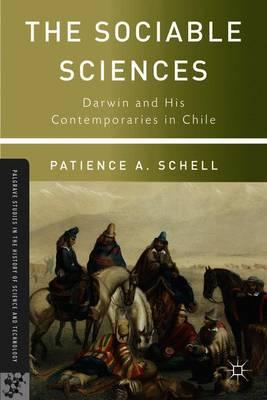
This beautifully written history traces the fortunes of Charles Darwin and his contemporaries in Chile. It explains how they showed Chileans a new way to see their own natural environment, teaching a younger generation of scientists there and forging international networks that helped to shape the modern world.
Full Product Details
Author: P. Schell
Publisher: Palgrave Macmillan
Imprint: Palgrave Macmillan
Dimensions:
Width: 14.00cm
, Height: 1.80cm
, Length: 21.60cm
Weight: 4.925kg
ISBN: 9781137286055
ISBN 10: 1137286059
Pages: 297
Publication Date: 10 April 2013
Audience:
College/higher education
,
Postgraduate, Research & Scholarly
Format: Hardback
Publisher's Status: Active
Availability: In Print

This item will be ordered in for you from one of our suppliers. Upon receipt, we will promptly dispatch it out to you. For in store availability, please contact us.
Reviews
'The Sociable Sciences narrates the daily life of naturalists in Chile, focusing on the middle fifty years of the nineteenth century. Darwin's visit to Chile is considered in detail, along with the life of Claude Gay, a French naturalist who resided in Chile for many years. Schell has made a persuasive argument for presenting the culture of discovery and exploration in Chile as a vital part of modern science, rather than as a 'case study' of peripheral interest. Her clear and strong prose commands a wide range of archival material from the New World and from Europe.' - Lewis Pyenson, Professor of History, Western Michigan University 'This is a wonderful, very well-written book with a very original approach. The narrative is especially coherent because the research programs of the book's protagonists were interlocking: Darwin and Gay were providing first accounts of many areas of the country and synthesizing them. The book will appeal to historians of science, of course, and not simply Latin Americanists: it is a model study of how affinity groups (social and professional networks) work in a particular setting, and the generalizations the author makes can be applied with profit to any society.' - Thomas F. Glick, Professor of History, Boston University
'The Sociable Sciences is an accessible and enjoyable book which brings the study of natural history to life. Nineteenth-century science was about book learning and careful observation, but it was also about human relationships and communities of exchange. Schell's colourful cast of characters illustrates the role of friendship in natural history, in an era when the aspiring naturalist needed to cultivate his personal relationships as carefully as his botanical specimens. - Archives of Natural History 'The Sociable Sciences narrates the daily life of naturalists in Chile, focusing on the middle fifty years of the nineteenth century. Darwin's visit to Chile is considered in detail, along with the life of Claude Gay, a French naturalist who resided in Chile for many years. Schell has made a persuasive argument for presenting the culture of discovery and exploration in Chile as a vital part of modern science, rather than as a 'case study' of peripheral interest. Her clear and strong prose commands a wide range of archival material from the New World and from Europe.' - Lewis Pyenson, Professor of History, Western Michigan University 'This is a wonderful, very well-written book with a very original approach. The narrative is especially coherent because the research programs of the book's protagonists were interlocking: Darwin and Gay were providing first accounts of many areas of the country and synthesizing them. The book will appeal to historians of science, of course, and not simply Latin Americanists: it is a model study of how affinity groups (social and professional networks) work in a particular setting, and the generalizations the author makes can be applied with profit to any society.' - Thomas F. Glick, Professor of History, Boston University
to come
Author Information
Patience A. Schell Chair of Hispanic Studies at the University of Aberdeen, Scotland, UK. She is the author of Church and State Education in Revolutionary Mexico City (2003), and co-editor of The Women's Revolution in Mexico: 1910-1953 (2007) and New Approaches to Resistance in Brazil and Mexico (2012).