Overview
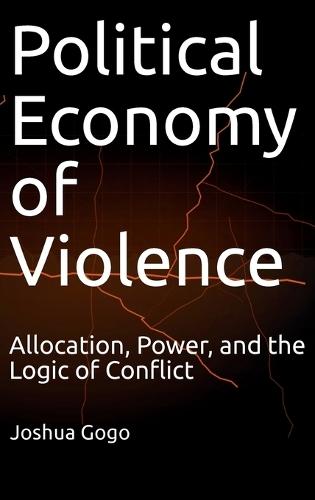
Why do some societies experience persistent instability while others sustain continuity, even under conditions of inequality? The Political Economy of Violence offers a rigorous and original framework for understanding conflict, instability, and the conditions for stability in complex systems. Moving beyond conventional explanations that focus on isolated causes, the book argues that violence is not accidental or irrational; it is a structural outcome of how systems allocate resources, distribute power, and sustain, or lose, legitimacy. At the center of the analysis is the concept of pressure: the tension generated by uneven allocation of resources, opportunities, and burdens. The book develops a unified model in which pressure accumulates within systems under conditions of constrained adjustment, or is displaced across systems through interdependence. These dynamics are formalized through a dual-loop framework: an internal loop in which pressure builds and escalates, and an external loop in which pressure is redistributed across interconnected systems, returning through feedback and sustaining instability at a broader scale. The book further introduces the MASI framework-Mobility, Access to Voice, Spatial Burden, and Welfare Gap-as a model of adjustment capacity, explaining how systems absorb, redistribute, or amplify pressure under varying structural conditions. Where these pathways are strong, pressure is managed; where they weaken, instability intensifies. Challenging traditional notions of equilibrium, the book redefines stability as a structural condition arising from the alignment of allocation, power, and legitimacy. Stability, in this framework, is not the absence of tension but the capacity of systems to organize and manage it. Misalignment between these elements produces persistent pressure, constrained adjustment, and the conditions under which conflict may escalate into violence. Integrating insights from political economy, development theory, and institutional analysis, this work provides a general theory of instability and violence applicable across diverse contexts, including resource-rich and developing economies. It offers scholars, policymakers, and practitioners a new lens for understanding how inequality, governance structures, and global interdependence interact to produce both stability and instability. Analytical, disciplined, and globally relevant, The Political Economy of Violence advances a central insight: systems do not fail because they contain tension; they fail because they lose the capacity to manage it.
Full Product Details
Author: Joshua Gogo
Publisher: Afcote Press
Imprint: Afcote Press
Dimensions:
Width: 15.60cm
, Height: 2.90cm
, Length: 23.40cm
Weight: 0.798kg
ISBN: 9781069482686
ISBN 10: 1069482684
Pages: 444
Publication Date: 15 May 2026
Audience:
General/trade
,
General
Format: Hardback
Publisher's Status: Active
Availability: Available To Order

We have confirmation that this item is in stock with the supplier. It will be ordered in for you and dispatched immediately.