Overview
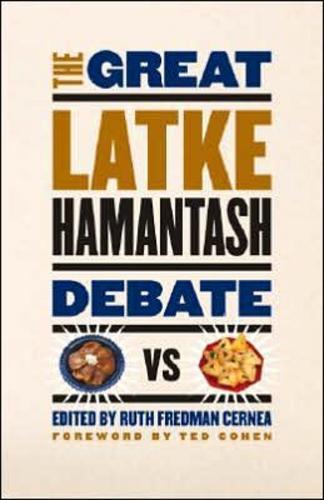
Creation versus evolution. Nature versus nurture. Free will versus determinism. Every November at the University of Chicago, the best minds in the world consider the question that ranks with these as one of the most enduring of human history: latke or hamantash? This great latke-hamantash debate, occurring every year for the past six decades, brings Nobel laureates, university presidents, and notable scholars together to debate whether the potato pancake or the triangular Purim pastry is in fact the worthier food. What began as an informal gathering is now an institution that has been replicated on campuses nationwide. Highly absurd yet deeply serious, the annual debate is an opportunity for both ethnic celebration and academic farce. In poetry, essays, jokes, and revisionist histories, members of elite American academies attack the latke-versus-hamantash question with intellectual panache and an unerring sense of humor, if not chutzpah. The Great Latke-Hamantash Debate is the first collection of the best of these performances, from Martha Nussbaum's paean to both foods—in the style of Hecuba's Lament—to Nobel laureate Leon Lederman's proclamation on the union of the celebrated dyad. The latke and the hamantash are here revealed as playing a critical role in everything from Chinese history to the Renaissance, the works of Jane Austen to constitutional law. Philosopher and humorist Ted Cohen supplies a wry foreword, while anthropologist Ruth Fredman Cernea provides historical and social context as well as an overview of the Jewish holidays, latke and hamantash recipes, and a glossary of Yiddish and Hebrew terms, making the book accessible even to the uninitiated. The University of Chicago may have split the atom in 1942, but it's still working on the equally significant issue of the latke versus the hamantash. “As if we didn’t have enough on our plates, here’s something new to argue about. . . . To have to pick between sweet and savory, round and triangular, latke and hamantash. How to choose? . . . Thank goodness one of our great universities—Chicago, no less—is on the case. For more than 60 years, it has staged an annual latke-hamantash debate. . . . So, is this book funny? Of course it’s funny, even laugh-out-loud funny. It’s Mickey Katz in academic drag, Borscht Belt with a PhD.”—David Kaufmann, Forward
Full Product Details
Author: Ruth Fredman Cernea ,
Ted Cohen
Publisher: The University of Chicago Press
Imprint: University of Chicago Press
Dimensions:
Width: 1.50cm
, Height: 0.20cm
, Length: 2.20cm
Weight: 0.454kg
ISBN: 9780226100234
ISBN 10: 0226100235
Pages: 250
Publication Date: 01 November 2005
Audience:
Professional and scholarly
,
Professional & Vocational
Format: Hardback
Publisher's Status: Active
Availability: Manufactured on demand

We will order this item for you from a manufactured on demand supplier.
Reviews
Hegel had the insight to see the oppositeness of the latke and the hamantash.... The latke is the thesis, the hamantash is the antithesis, so he cunningly insisted that there must be a synthesis, and we can all relax. - Alan Bloom, Committee on Social Thought, University of Chicago, 1981 Though David admired Bathsheba's torso He liked her hamantashen more so. - Ralph Marcus, Department of Hellenistic Culture, University of Chicago, 1953
""Hegel had the insight to see the oppositeness of the latke and the hamantash.... The latke is the thesis, the hamantash is the antithesis, so he cunningly insisted that there must be a synthesis, and we can all relax."" - Alan Bloom, Committee on Social Thought, University of Chicago, 1981 ""Though David admired Bathsheba's torso He liked her hamantashen more so."" - Ralph Marcus, Department of Hellenistic Culture, University of Chicago, 1953""
Author Information
Ruth Fredman Cernea is an anthropologist and the author of The Passover Seder and Two Promised Lands: Baghdadi Jews in Burma. She is the former international director of publications and resources at the Hillel Foundation and former editor of The Hillel Guide to Jewish Life on Campus.