Overview
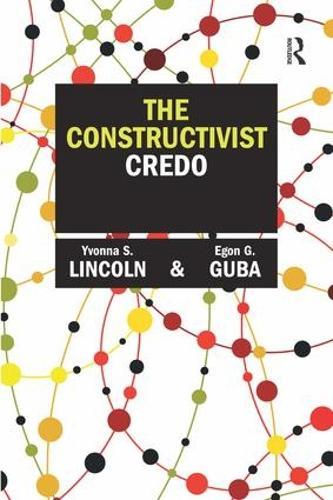
The Constructivist Credo is a set of foundational principles for those wishing to conduct social science research within the constructivist paradigm. They were distilled by Yvonna Lincoln and Egon Guba from their many writings on this topic and are provided in the form of 150 propositional statements. After Guba’s death in 2008, the Credo was completed by Lincoln and is presented here. In addition to the key principles of constructivist thought, the volume also contains an introduction to constructivism, an intellectual biography and complete bibliography of Guba’s work, and a case study using constructivism, showing how the paradigm can be applied to a research study.
Full Product Details
Author: Yvonna S Lincoln ,
Egon G Guba
Publisher: Left Coast Press Inc
Imprint: Left Coast Press Inc
Dimensions:
Width: 15.20cm
, Height: 1.50cm
, Length: 22.90cm
Weight: 0.340kg
ISBN: 9781598746907
ISBN 10: 1598746901
Pages: 208
Publication Date: 30 April 2013
Audience:
Professional and scholarly
,
Professional & Vocational
Format: Paperback
Publisher's Status: Active
Availability: In Print

This item will be ordered in for you from one of our suppliers. Upon receipt, we will promptly dispatch it out to you. For in store availability, please contact us.
Reviews
""...A valuable resource for any qualitative researcher who considers himself a constructivist. The ideas presented help make the paradigm clearer and provide inspiration for deep reflection about the importance of being open to ideas and willing to 'reconstruct' truths when new information is discovered."" --Michele Repass, The Qualitative Report ""Lincoln and Guba have taken great care to elaborate on constructivism and show researchers the paradigm's systematic approach. The book may serve as a foundational work in the qualitative literature, influencing constructivists to push the boundaries of qualitative research toward better understanding of the human instrument as well as toward more equitable and inclusive evaluation models....The book also offers guidance to evaluators for engaging in effective evaluation that includes all those impacted by a program or policy."" --Sheila Fram, American Journal of Evaluation
Lincoln and Guba have taken great care to elaborate on constructivism and show researchers the paradigm s systematic approach. The book may serve as a foundational work in the qualitative literature, influencing constructivists to push the boundaries of qualitative research toward better understanding of the human instrument as well as toward more equitable and inclusive evaluation models .The book also offers guidance to evaluators for engaging in effective evaluation that includes all those impacted by a program or policy. Sheila Fram, American Journal of Evaluation ...A valuable resource for any qualitative researcher who considers himself a constructivist. The ideas presented help make the paradigm clearer and provide inspiration for deep reflection about the importance of being open to ideas and willing to 'reconstruct' truths when new information is discovered. Michele Repass, The Qualitative Report Lincoln and Guba have taken great care to elaborate on constructivism and show researchers the paradigm's systematic approach. The book may serve as a foundational work in the qualitative literature, influencing constructivists to push the boundaries of qualitative research toward better understanding of the human instrument as well as toward more equitable and inclusive evaluation models....The book also offers guidance to evaluators for engaging in effective evaluation that includes all those impacted by a program or policy. --Sheila Fram, American Journal of Evaluation .. .A valuable resource for any qualitative researcher who considers himself a constructivist. The ideas presented help make the paradigm clearer and provide inspiration for deep reflection about the importance of being open to ideas and willing to 'reconstruct' truths when new information is discovered. --Michele Repass, The Qualitative Report
Lincoln and Guba have taken great care to elaborate on constructivism and show researchers the paradigm's systematic approach. The book may serve as a foundational work in the qualitative literature, influencing constructivists to push the boundaries of qualitative research toward better understanding of the human instrument as well as toward more equitable and inclusive evaluation models....The book also offers guidance to evaluators for engaging in effective evaluation that includes all those impacted by a program or policy. --Sheila Fram, American Journal of Evaluation
Lincoln and Guba have taken great care to elaborate on constructivism and show researchers the paradigm's systematic approach. The book may serve as a foundational work in the qualitative literature, influencing constructivists to push the boundaries of qualitative research toward better understanding of the human instrument as well as toward more equitable and inclusive evaluation models....The book also offers guidance to evaluators for engaging in effective evaluation that includes all those impacted by a program or policy. --Sheila Fram, American Journal of Evaluation .. .A valuable resource for any qualitative researcher who considers himself a constructivist. The ideas presented help make the paradigm clearer and provide inspiration for deep reflection about the importance of being open to ideas and willing to 'reconstruct' truths when new information is discovered. --Michele Repass, The Qualitative Report Lincoln and Guba have taken great care to elaborate on constructivism and show researchers the paradigm s systematic approach. The book may serve as a foundational work in the qualitative literature, influencing constructivists to push the boundaries of qualitative research toward better understanding of the human instrument as well as toward more equitable and inclusive evaluation models .The book also offers guidance to evaluators for engaging in effective evaluation that includes all those impacted by a program or policy. Sheila Fram, American Journal of Evaluation ...A valuable resource for any qualitative researcher who considers himself a constructivist. The ideas presented help make the paradigm clearer and provide inspiration for deep reflection about the importance of being open to ideas and willing to 'reconstruct' truths when new information is discovered. Michele Repass, The Qualitative Report
Author Information
Yvonna S. Lincoln, Egon G. Guba