Overview
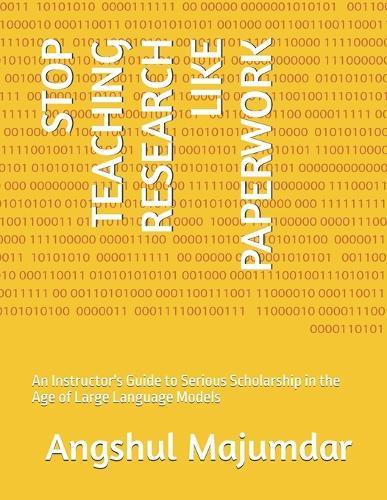
Most research-methodology teaching is fraud dressed as pedagogy. It teaches the visible paperwork of research because paperwork is easy to inspect: objectives, gaps, literature reviews, methodologies, hypotheses, experiments, rubrics, conclusions, and formatted submissions. The tragedy is that none of this proves that research has happened. It only proves that the student has learned to imitate the external shape of research. Large Language Models have made this collapse impossible to hide. A machine can now produce a polished proposal, a respectable literature review, a plausible methodology, and a confident conclusion in minutes. If an instructor only teaches format, templates, structure, and academic theatre, that instructor has already been replaced. The machine can perform that job faster, cheaper, and with less self-importance. This book is written for instructors who still want to matter. It does not treat LLMs as magic. It does not worship prompt engineering. It does not pretend that research can be automated by asking a chatbot for ideas. LLMs are powerful, unreliable instruments for compressing the labour of research: reading, comparison, formulation, coding, critique, revision, simplification, enrichment, and adversarial checking. They can expose weak arguments, generate alternatives, test assumptions, simulate reviewers, design baselines, and help students see where their own claims collapse. But they do not supply judgement. They do not supply taste. They do not supply courage. They do not know whether a problem is worth solving. That burden remains with the instructor. The central argument of this book is simple: research education must stop rewarding decorated garbage. A fluent literature review is not scholarship. A methodology diagram is not a contribution. A long reference list is not understanding. A polished thesis chapter is not evidence of thought. In the age of LLMs, academic polish has become cheap. What remains valuable is the ability to ask whether the problem is real, whether the gap survives scrutiny, whether the method is justified, whether the experiments mean anything, and whether the claim can withstand attack. This book is a guide to teaching that discipline. It shows how instructors can use LLMs to train students in problem discovery, literature compression, gap testing, methodology development, experimental design, writing, presentation, reviewing, and long-horizon research workflows. The goal is not to help students produce better-looking submissions. The goal is to make them harder to fool, harder to flatter, and harder to defeat. If research teaching remains polite, procedural, and template-driven, it deserves to be automated away. If it becomes rigorous, adversarial, and intellectually honest, LLMs can make it sharper than ever.
Full Product Details
Author: Angshul Majumdar
Publisher: Independently Published
Imprint: Independently Published
Dimensions:
Width: 21.60cm
, Height: 1.10cm
, Length: 27.90cm
Weight: 0.490kg
ISBN: 9798196655241
Pages: 206
Publication Date: 12 May 2026
Audience:
General/trade
,
General
Format: Paperback
Publisher's Status: Active
Availability: Available To Order

We have confirmation that this item is in stock with the supplier. It will be ordered in for you and dispatched immediately.