Overview
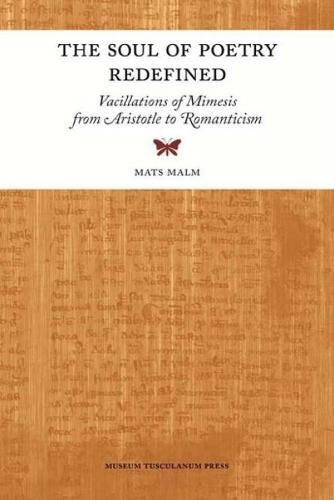
What is the soul of poetry? Perhaps the most influential answer comes from Aristotle’s Poetics, in which the writer regarded poetry as an instance of mimesis, a kind of representation or simulation. However, despite the significance he gave the term, Aristotle's use of the word mimesis was far from unequivocal, and over the centuries that have followed this inconsistency has stimulated a wealth of interpretations and debate. Tracking Poetics from its birth in rhetorical studies to its reception across the centuries until romanticism, Mats Malm here examines the many different ways scholars—from Averroës to Schlegel—have understood mimesis, looking at how these various interpretations have led to very different definitions of the soul of poetry.
Full Product Details
Author: Mats Malm
Publisher: Museum Tusculanum Press
Imprint: Museum Tusculanum Press
Dimensions:
Width: 1.70cm
, Height: 0.20cm
, Length: 2.40cm
Weight: 0.624kg
ISBN: 9788763537421
ISBN 10: 8763537427
Pages: 238
Publication Date: 07 July 2012
Audience:
College/higher education
,
Professional and scholarly
,
Tertiary & Higher Education
,
Professional & Vocational
Format: Hardback
Publisher's Status: Active
Availability: Available To Order

We have confirmation that this item is in stock with the supplier. It will be ordered in for you and dispatched immediately.
Reviews
A valuable contribution to the study of mimesis and of the long-standing influence of Aristotle in Western aesthetics. --P. I. Vieira Choice A valuable contribution to the study of mimesis and of the long-standing influence of Aristotle in Western aesthetics. --P. I. Vieira Choice
"""A valuable contribution to the study of mimesis and of the long-standing influence of Aristotle in Western aesthetics.""--P. I. Vieira ""Choice"" ""'Aristotle, I have been told, has said that Poetry is the most philosophical of all writing . . .' Carefully holding Aristotle's Poetics at a distance while yet claiming it as a critical authority, Wordsworth's bit of hearsay in the preface to Lyrical Ballads is a rhetorical gesture with a long history. The poet was but one in a long line of writers eager to cite Aristotle's poetic dicta while radically and fruitfully redefining the basic terms of Aristotle's argument. Mats Malm's The Soul of Poetry Redefined represents a welcome attempt to clarify the various, ever-changing meanings attached to some of these basic terms--most notably mimesis, diction, and verisimilitude--amid the reception and interpretation of the Poetics from the twelfth to the eighteenth century.""-- ""Comparative Literature Studies"""
""A valuable contribution to the study of mimesis and of the long-standing influence of Aristotle in Western aesthetics.""--P. I. Vieira ""Choice"" ""'Aristotle, I have been told, has said that Poetry is the most philosophical of all writing . . .' Carefully holding Aristotle's Poetics at a distance while yet claiming it as a critical authority, Wordsworth's bit of hearsay in the preface to Lyrical Ballads is a rhetorical gesture with a long history. The poet was but one in a long line of writers eager to cite Aristotle's poetic dicta while radically and fruitfully redefining the basic terms of Aristotle's argument. Mats Malm's The Soul of Poetry Redefined represents a welcome attempt to clarify the various, ever-changing meanings attached to some of these basic terms--most notably mimesis, diction, and verisimilitude--amid the reception and interpretation of the Poetics from the twelfth to the eighteenth century.""-- ""Comparative Literature Studies""
A valuable contribution to the study of mimesis and of the long-standing influence of Aristotle in Western aesthetics. --P. I. Vieira Choice
A valuable contribution to the study of mimesis and of the long-standing influence of Aristotle in Western aesthetics. --P. I. Vieira Choice 'Aristotle, I have been told, has said that Poetry is the most philosophical of all writing . . .' Carefully holding Aristotle's Poetics at a distance while yet claiming it as a critical authority, Wordsworth's bit of hearsay in the preface to Lyrical Ballads is a rhetorical gesture with a long history. The poet was but one in a long line of writers eager to cite Aristotle's poetic dicta while radically and fruitfully redefining the basic terms of Aristotle's argument. Mats Malm's The Soul of Poetry Redefined represents a welcome attempt to clarify the various, ever-changing meanings attached to some of these basic terms--most notably mimesis, diction, and verisimilitude--amid the reception and interpretation of the Poetics from the twelfth to the eighteenth century. --Comparative Literature Studies
Author Information
Mats Malm is Professor of Department of Literature, History of Ideas and Religion at the University of Gothenburg.