|
|
|||
|
||||
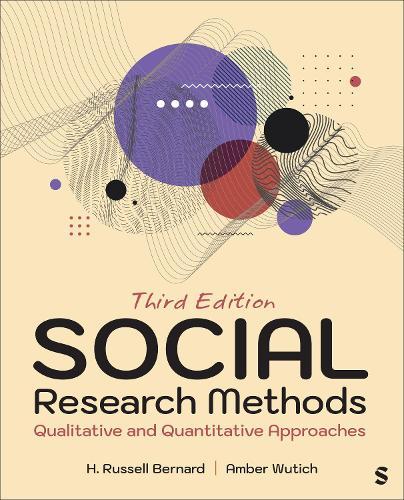
OverviewSocial Research Methods: Qualitative and Quantitative Approaches equips students with the tools they need to conduct meaningful research across the social sciences. By blending qualitative and quantitative methods, it helps graduate students not only understand how to use research techniques—but also when and why to use them. Full Product DetailsAuthor: H. Russell Bernard , Amber WutichPublisher: SAGE Publications Inc Imprint: SAGE Publications Inc Edition: 3rd Revised edition Weight: 1.130kg ISBN: 9781544396545ISBN 10: 1544396546 Pages: 664 Publication Date: 14 May 2026 Audience: College/higher education , Tertiary & Higher Education Format: Paperback Publisher's Status: Forthcoming Availability: Not yet available This item is yet to be released. You can pre-order this item and we will dispatch it to you upon its release. Table of ContentsPreface Acknowledgments About the Authors Chapter 1: The Foundations of Social Research Introduction What Is Social Science Research? Ethics and Social Science The Language and Logic of Social Research Variables: The Joy of Measurement Concepts and Measurement Conceptual and Operational Definitions Levels of Measurement Validity, Reliability, Accuracy, and Precision Is My Measure Any Good? Determining Validity The Problem with Validity The Bottom Line Key Concepts In This Chapter Summary Exercises Further Reading Chapter 2: Preparing For Research Setting Things Up Ethics of Social Research Theory—Explanation and Prediction A Guide to Finding Research Questions, Anyway Generating Types of Studies The Literature Search Meta-Analysis Key Concepts in This Chapter Summary Exercises Further Reading Chapter 3: Research Design Introduction: What Is Research Design? About Numbers and Words: The Qualitative/Quantitative Split Cause and Effect Units of Analysis Three Decisions in Research Design The Eight Types of Research Design Mixed-methods Research Designs Participatory and Action Research The Components of a Research Design The Art of Proposal Writing How to Develop Your Proposal with Mentors and Peers Key Concepts in This Chapter Summary Exercises Further Reading Chapter 4: Experiments In Social Science The Logic Of The Experimental Method Internal and External Validity Controlling for Threats to Validity Factorial Designs: Main Effects and Interaction Effects Field Experiments Are Field Experiments Ethical? Thought Experiments Key Concepts in This Chapter Summary Exercises Further Reading Chapter 5: Scales And Scaling Introduction Single-question Scales Single-indicator Graphic Representational Scales Composite (or Complex) Scales: Multiple Indicators Indexes Guttman Scales Likert Scales Item Analysis Testing for Unidimensionality with Factor Analysis The Semantic Differential And Finally . . . Key Concepts in This Chapter Summary Exercises Further Reading Chapter 6: Probability Sampling What Are Samples and Why Do We Need Them? Why Samples Can Be More Accurate than Counts Sampling Frames Stratified Sampling Cluster Sampling Probability Proportionate to Size How Big Should a Sample Be? Probability Distributions The Normal Curve and the Standard Deviation The Central Limit Theorem The Standard Error and Confidence Intervals Small Samples: The t-Distribution Estimating Proportions Key Concepts in This Chapter Summary Exercises Further Reading Chapter 7: Nonprobability Sampling Introduction Reasons to Use a Non-Probability Sample Four Common and Two Uncommon Types of Non-Probability Samples Minimum Sizes for Different Types of Nonprobability Samples Deciding on a nonprobability sampling method and sample size And Finally . . . Key Concepts in This Chapter Summary Exercises Further Reading Chapter 8: Interviewing and Focus Groups The Big Picture Interview Control Unstructured Interviewing Probing Learning to Interview Positionality and Presentation of Self Using a Voice Recorder Using Visual Cues, Like Photos in Interviews Focus Groups Response Effects Respondent/Informant Accuracy Key concepts in this Chapter Summary Exercises Further Reading Chapter 9: Survey Research Introduction Methods for Collecting Questionnaire Data When to Use what Working with Interviewers Closed- Versus Open-ended Questions Fourteen Rules for Question Wording and Format Pretesting and Learning from Mistakes Translation and Back Translation The Response Rate Problem Improving the Response Rate: Dillman’s Total Design Method Cross-sectional and Longitudinal Studies Some Specialized Survey Methods Key concepts in this Chapter Summary Exercises Further Reading Chapter 10: Collecting Social Network Data Social Networks Two Kinds of Social Networks Doing Network Analysis Collecting Whole (Sociocentric) Network Data Collecting Personal (Egocentric) Network Data Key concepts in this Chapter Summary Exercises Further Reading Chapter 11: Fieldwork: Direct and Participant Observation Introduction Some History: Observing Behavior in the Lab Direct Observation in the Wild Reactive Observation: Continuous Monitoring and Spot Sampling Spot Sampling A Few Final Words on Reactive Observation Unobtrusive Observation Disguised Field Observation Indirect Observation Participant Observation Different Roles in Participant Observation Doing Participant Observation The Skills of a Participant Observer Hanging Out, Gaining Rapport Objectivity Insider Research: Studying Your Own Culture Gender, Parenting, and Other Personal Characteristics Sex and Fieldwork Surviving Fieldwork Leaving the Field Key concepts in this Chapter Summary Exercises Further Reading Chapter 12: Analyzing Text: Grounded Theory and Content Analysis Introduction Overview of Grounded Theory Content Analysis Doing Classical Content Analysis Intercoder Reliability Automated Content Analysis: Content Dictionaries AI and Text Analysis Key Concepts in this Chapter Summary Exercises Further Reading Chapter 13: Discourse Analysis Introduction Conversation Analysis Taking Turns in a Jury Narrative Analysis Phenomenological Analysis of Narratives Language in Use Critical Discourse Analysis: Language and Power Key Concepts in This Chapter Summary Exercises Further Reading Chapter 14: Univariate and Bivariate Analysis Introduction Univariate Analysis: Raw Data Frequency Distributions Measures of Central Tendency Outliers and Skewness Visualizing Data Measures of Dispersion: Variance and the Standard Deviation The Logic of Hypothesis Testing Testing the Means of Large Samples: Using z-Scores The Univariate Chi-square Test Testing Relations: Bivariate Analysis The t test: Comparing Two Means ANOVA—Analysis of Variance Visualizing the Direction and Shape of Covariations Crosstabs of Nominal Variables Correlation and Cause: Antecedent and Intervening Variables Chi-Square for Bivariate Comparisons Testing the Association between Ordinal Variables What to Use for Nominal and Ordinal Variables Correlation: The Powerhouse Statistic for Covariation Regression Advantages and disadvantages of r and r^2 Nonlinear Relations Statistical Significance, the Shotgun Approach, and Other Issues Key Concepts in This Chapter Summary Exercises Further Reading Chapter 15: Multivariate Analysis Introduction Elaboration: Controlling for Independent Variables Car Wrecks and Teenage Births The Multiple Regression Equation Using Multiple Regression to Solve the MVD-TEENBIRTH Puzzle Path Analysis Factor Analysis Discriminant Function Analysis (DFA) And Finally . . . Key Concepts in This Chapter Summary Exercises Further Reading Chapter 16: Analyzing Network Data Introduction: About Matrices Analyzing Relational Data: MDS and Cluster Analysis Analyzing Social Network Data Analyzing Whole (Sociocentric) Network Data Analyzing Personal (Egocentric) Network Data “It’s Not what You Know, It’s Who You Know” Adding Network Data to the Classic Recipe Affiliation Matrices Semantic Networks Key Concepts in This Chapter Summary Exercises Further Reading Chapter 17: On Writing Up Introduction Getting Your Article Published BibliographyReviewsThe main strength of this text is coverage of both quantitative and qualitative methodology from a broad range of fields. The examples are often my students′ favorite thing to discuss in class. -- Erica B. Gibson The depth of detailed descriptions (foundations of social research; interviewing, participant observation, field notes, and data analysis) go beyond other texts…the organization is superb. -- Benedict J. Colombi This text does an excellent job of not only showing how to practice research but also provides a detailed discussion of broader historical and philosophical contexts that are important for understanding research. -- Julian Kilker Author InformationH. Russell Bernard is director of the Institute for Social Science Research at Arizona State University and Professor Emeritus of Anthropology of the University of Florida. He is a cultural anthropologist specializing in technology and social change, language revitalization, and social network analysis. Bernard has done research or taught at universities in the United States, Mexico, Greece, Japan, and Germany. He is a former editor of Human Organization and the American Anthropologist and is the founder and editor of the journal Field Methods. Bernard’s books include Research Methods in Anthropology and Social Research Methods (both with Amber Wutich); Analyzing Qualitative Data (with Gery Ryan and Amber Wutich); and Native Ethnography (with Jesús Salinas Pedraza). Bernard was the 2003 recipient of the Franz Boas Award and the 2024 recipient of the Conrad Arensberg Award from the American Anthropological Association and is a member of the U.S. National Academy of Sciences. Amber Wutich is a Regents & President’s Professor of Anthropology at Arizona State University, a MacArthur Fellow, and Director of ASU’s Center for Global Health. An ethnographer and methodologist, Wutich has authored 200+ papers, co-edits the journal Field Methods, and directs the NSF Cultural Anthropology Methods Program. Her two decades of community-based fieldwork explores how people respond, individually and collectively, to extremely water-scarce conditions. An expert on water insecurity, Wutich directs the Global Ethnohydrology Study, a cross-cultural study of water knowledge and management in 20+ countries. She leads Arizona Water for All, a participatory study that develops collaborative water solutions with water-insecure U.S. communities. Wutich’s books include The Human Story: An Introduction to Anthropology (with Alexandra Brewis, Kelly Knudson, Christopher Stojanowski, and Cindi SturtzSreetharan), Lazy, Crazy, Disgusting: Stigma and the Undoing of Global Health (with Alexandra Brewis), Research Methods in Anthropology and Social Research Methods (both with H. Russell Bernard); and Analyzing Qualitative Data (with H. Russell Bernard and Gery Ryan). Tab Content 6Author Website:Countries AvailableAll regions |
||||