Overview
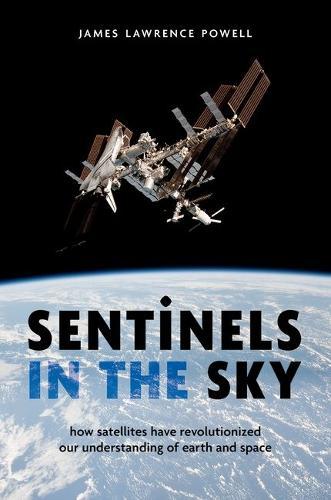
Since the launch of Sputnik in 1957, satellites have become the silent sentinels of our planet and the cosmos. Orbiting high above, they have changed the way we live, the way we think, and most profoundly, the way we see. In Sentinels in the Sky: How Satellites Have Revolutionized Our Understanding of Earth and Space, geologist and author James Lawrence Powell tells the remarkable story of how satellites have revolutionized science-transforming fields from geology to astronomy, meteorology to climate science, and agriculture to archaeology. What began as a Cold War contest to launch the first artificial satellite has evolved into a global enterprise in space-based observation, delivering a continuous stream of data about our planet and its place in the universe. Today's satellites measure Earth's temperature, vegetation, sea level, and ice cover with unmatched precision. They detect wildfires in remote forests, monitor hurricanes as they form, and track the movements of animals across continents. Without them, we would know far less about climate change, deforestation, drought, and the health of ecosystems on land and sea. But satellites do more than study Earth-they also extend our reach into space. They discover distant galaxies, observe black holes and supernovae, trace gravitational waves, and map the faint microwave afterglow of the Big Bang itself. Thanks to satellites, we have become explorers of both our own world and the wider universe. With clarity, authority, and a storyteller's touch, Powell brings to life the science, people, and technology behind one of the most transformative innovations of the modern age. Sentinels in the Sky is a compelling account of how humanity learned to observe the Earth from above-and why that view may be our best hope for understanding and preserving it.
Full Product Details
Author: James Lawrence Powell (Independent Scholar, Independent Scholar)
Publisher: Oxford University Press Inc
Imprint: Oxford University Press Inc
Dimensions:
Width: 16.50cm
, Height: 1.30cm
, Length: 23.40cm
Weight: 0.626kg
ISBN: 9780197842829
ISBN 10: 0197842828
Pages: 248
Publication Date: 04 June 2026
Audience:
General/trade
,
General
Format: Hardback
Publisher's Status: Active
Availability: To order

Stock availability from the supplier is unknown. We will order it for you and ship this item to you once it is received by us.
Author Information
James Lawrence Powell holds a Ph.D. in geochemistry from MIT and has served as a college professor, president of three colleges, and as a member of the National Science Board under two U.S. Presidents. He directed the Los Angeles County Museum of Natural History and the Glenn T. Seaborg Center. An accomplished author, Powell has written numerous books on geology, climate change, planetary science, and the history of science. His career bridges academic leadership and public science communication, with a focus on explaining complex scientific ideas to general audiences.