Overview
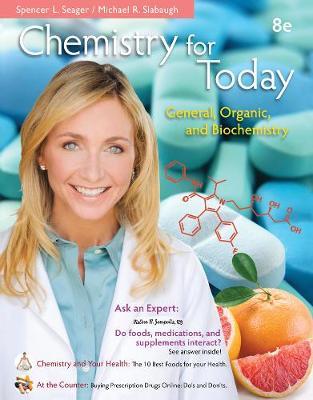
Succeed in your course using this lab manual's unique blend of laboratory skills and exercises that effectively illustrate concepts from the main text, CHEMISTRY FOR TODAY: GENERAL, ORGANIC, AND BIOCHEMISTRY, 8e. The book's 15 general chemistry and 20 organic/biochemistry safety-scale laboratory experiments use small quantities of chemicals and emphasize safety and proper disposal of materials. ""Safety-scale' is the authors' own term for describing the amount of chemicals each lab experiment requires--less than macroscale quantities, which are expensive and hazardous, and more than microscale quantities, which are difficult to work with and require special equipment.
Full Product Details
Author: Spencer Seager (University of South Dakota) , Spencer Seager (Weber State University) , Michael Slabaugh (Weber State University)
Publisher: Cengage Learning, Inc
Imprint: Brooks/Cole
Edition: 8th edition
Dimensions:
Width: 21.50cm
, Height: 26.90cm
, Length: 2.50cm
Weight: 1.120kg
ISBN: 9781133604259
ISBN 10: 1133604250
Pages: 544
Publication Date: 01 January 2013
Audience:
College/higher education
,
General/trade
,
Tertiary & Higher Education
Replaced By: 9781305968554
Format: Paperback
Publisher's Status: Active
Availability: Temporarily unavailable 
The supplier advises that this item is temporarily unavailable. It will be ordered for you and placed on backorder. Once it does come back in stock, we will ship it out to you.
Table of Contents
Experiment 1 Measurements and Significant Figures Experiment 2 The Use of Chemical Balances Experiment 3 The Use of Volumetric Ware and the Determination of Density Experiment 4 Physical and Chemical Changes Experiment 5 Separations and Analysis Experiment 6 Classification of Chemical Reactions Experiment 7 Analysis Using Decomposition Reactions Experiment 8 Gas Laws Experiment 9 Solution Formation and Characteristics Experiment 10 Colligative Properties of Solutions Experiment 11 Reaction Rates and Equilibrium Experiment 12 Acids, Bases, Salts, and Buffers 167 Experiment 13 Analysis of Vinegar Experiment 14 Determination of Ka for Weak Acids Experiment 15 The Acidic Hydrogens of Acids Experiment 16 The Use of Melting Points in the Identification of Organic Compounds Experiment 17 Isolation and Purification of an Organic Compound Experiment 18 Hydrocarbons Experiment 19 Reactions of Alcohols and Phenols Experiment 20 Reactions of Aldehydes and Ketones Experiment 21 Reactions of Carboxylic Acids, Amines, and Amides Experiment 22 The Synthesis of Aspirin and Other Esters Experiment 23 Identifying Functional Groups in Unknowns Experiment 24 Synthetic Polymers Experiment 25 Dyes, Inks, and Food Colorings Experiment 26 A Study of Carbohydrates Experiment 27 Preparation of Soap By Lipid Saponification Experiment 28 Isolation of Natural Products: Trimyristin and Cholesterol Experiment 29 Amino Acids and Proteins Experiment 30 Enzymes: Nature’s Catalysts Experiment 31 Factors That Influence Enzyme Activity Experiment 32 Vitamin C Content of Foods, Part I: Assigned Samples Experiment 33 Vitamin C Content of Foods, Part II: Samples from Home Experiment 34 Extraction of DNA from Wheat Germ Experiment 35 Detection of Minerals in Breakfast Cereals Appendix A Graphs and Graphing Appendix B Equipment, Chemicals, Reagents, and Supplies Appendix C Table of Atomic Weights and Numbers
Reviews
1. Matter, Measurements, and Calculations. 2. Atoms and Molecules. 3. Electronic Structure and the Periodic Law. 4. Forces Between Particles. 5. Chemical Reactions. 6. The States of Matter. 7. Solutions and Colloids. 8. Reaction Rates and Equilibrium. 9. Acids, Bases, and Salts. 10. Radioactivity and Nuclear Processes. 11. Organic Compounds: Alkanes. 12. Unsaturated Hydrocarbons. 13. Alcohols, Phenols, and Ethers. 14. Aldehydes and Ketones. 15. Carboxylic Acids and Esters. 16. Amines and Amides. 17. Carbohydrates. 18. Lipids. 19. Proteins. 20. Enzymes. 21. Nucleic Acids and Protein Synthesis. 22. Nutrition and Energy for Life. 23. Carbohydrate Metabolism. 24. Lipid and Amino Acid Metabolism. 25. Body Fluids. Appendix A: The International System of Measurements. Appendix B: Answers to Even-Numbered End-of-Chapter Exercises. Appendix C: Solutions to Learning Checks. Glossary. Index.
Author Information
Michael R. Slabaugh is Professor of Chemistry at Weber State University, where he teaches the year-long sequence of General, Organic, and Biochemistry. He received his B.S. in chemistry from Purdue and his Ph.D. in organic chemistry from Iowa State University. His interest in plant alkaloids led to a year of postdoctoral study in biochemistry at Texas A & M. His current professional interests are chemistry education and community involvement in science activities, particularly the State Science and Engineering Fair in Utah. Spencer L. Seager is Professor of Chemistry at Weber State University, where he served as chemistry department chairman from 1969 until 1993. He teaches general and physical chemistry at the university and is also active in projects to help improve chemistry and other science education in local elementary schools. He received his B.S. in chemistry and Ph.D. in physical chemistry from the University of Utah.
Tab Content 6
Author Website:
Countries Available
All regions
|