Overview
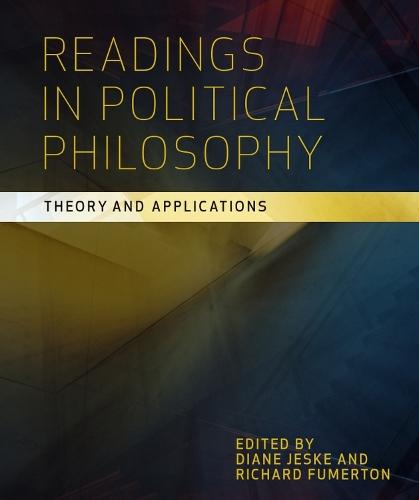
This anthology provides a survey of important issues in Western political thought, from Plato to the present day. Its aim is to show both the continuity and the development of the issues over time. Most of the sections begin with theoretical discussions of fundamental principles underlying the issues at hand. Theory is also connected to practice; the book includes articles that apply theoretical principles to contemporary issues, and also includes court cases and other political documents.
Full Product Details
Author: Richard Fumerton , Diane Jeske
Publisher: Broadview Press Ltd
Imprint: Broadview Press Ltd
Dimensions:
Width: 19.70cm
, Height: 4.30cm
, Length: 23.50cm
Weight: 0.500kg
ISBN: 9781551117652
ISBN 10: 1551117657
Pages: 1000
Publication Date: 20 December 2011
Audience:
General/trade
,
Professional and scholarly
,
General
,
Professional & Vocational
Format: Paperback
Publisher's Status: Active
Availability: Available To Order 
We have confirmation that this item is in stock with the supplier. It will be ordered in for you and dispatched immediately.
Table of Contents
Preface General Introduction UNIT 1 The State of Nature and the Nature of the State: Understanding Political Obligation Introduction A. Classical Social Contract Theory and Contemporary Developments Plato, selection from The Republic (c. 380 BCE) Thomas Hobbes, selection from Leviathan (1651) John Locke, selection from Second Treatise of Government (1689) Jean-Jacques Rousseau, selection from The Social Contract (1762) David Gauthier, selection from Morals by Agreement (1986) Robert Nozick, selections from Anarchy, State, and Utopia (1977) John Rawls, selection from A Theory of Justice (1971) B. Critiques of Contract Theory David Hume, “Of the Original Contract” (1752) A. John Simmons, selection from Moral Principles and Political Obligations (1979) Carole Pateman, “Contract, the Individual, and Slavery” (1988) Charles W. Mills, “Race and the Social Contract Tradition” (2000) C. Alternatives to Contract Theory FAIR PLAY Robert Nozick, selection from Anarchy, State, and Utopia (1977) Richard Arneson, “The Principle of Fairness and Free-Rider Problems” (1982) ASSOCIATIVE OBLIGATIONS Samuel Scheffler, “Relationships and Responsibilities” (1997) Diane Jeske, “Special Relationships and the Problem of Political Obligations” (2001) D. Applications Thomas Jefferson, et al., “The Declaration of Independence” (1776) Martin Luther King, Jr., “Letter from Birmingham Jail” (1963) Henry David Thoreau, “Resistance to Civil Government” (1849) United Nations Declaration on the Rights of Indigenous Peoples (2007) H.L.A. Hart, selection from The Concept of Law (1961) UNIT II Rights, Liberty, and the Limits of Government Introduction A. The Nature of Rights The United Nations Declaration of Human Rights (1948) Jeremy Bentham, selection from “Anarchical Fallacies” (written between 1791 and 1795, published 1816) John Stuart Mill, selection from Utilitarianism (1863) H.L.A. Hart, “Are There Any Natural Rights?” (1955) Robert Nozick, selection from Anarchy, State, and Utopia (1977) Diane Jeske and Richard Fumerton, “The Right and Wrong Ways to Think about Rights and Wrongs” (2010; written for this volume) B. Utilitarianism and Rights Jeremy Bentham, selection from The Principles of Morals and Legislation (1780) John Stuart Mill, selection from Utilitarianism (1863) E.F. Carritt, selection from Ethical and Political Thinking (1950) J.J.C. Smart (with Bernard Williams), selection from Utilitarianism: For and Against (1973) L.W. Sumner, “Rights” (2000) C. Do We Have a Right to Liberty? Thomas Hobbes, selection from Leviathan (1651) John Stuart Mill, selection from On Liberty (1859) Isaiah Berlin, selection from “Two Concepts of Liberty” (1958) Milton Friedman, selection from Capitalism and Freedom (1962) Ronald Dworkin, “What Rights Do We Have?” (1977, 1978) D. The Enforcement of Morality John Stuart Mill, selection from On Liberty (1859) Patrick Devlin, “Morals and the Criminal Law” (1960) Joel Feinberg, selection from Offense to Others (1988) George Sher, “Liberal Neutrality and the Value of Autonomy” (1995) E. Applications FREE SPEECH Village of Skokie v. National Socialist Party of America (1978) R. v. Keegstra (1990) Owens v. Saskatchewan (Human Rights Commission) (2006) Adam Liptak, “Hate Speech or Free Speech? What Much of West Bans Is Protected in U.S.” (2008) Texas v. Johnson (1989) R. v. Butler (1992) Miller v. California (1973) Ronald Dworkin, selection from “Is There a Right to Pornography?” (1981) American Booksellers Association v. Hudnut (1985) Catharine A. MacKinnon, selection from Toward a Feminist Theory of the State (1989) SEX, FREEDOM, AND MARRIAGE Bradwell v. Illinois (1872) John Stuart Mill, selections from The Subjection of Women (1869) Bowers v. Hardwick (1986) Lawrence v. Texas (1998) Susan Moller Okin, selection from Justice, Gender, and the Family (1991) Andrew Sullivan, “The Conservative Case” (1995) Loving v. Virginia (1967) Selection from Marriage Cases, Supreme Court of California (2008) Statement of Proposition 8 (2008) State (Utah) v. Holm (2006) Cheshire Calhoun, “Who’s Afraid of Polygamous Marriage? Lessons for Same-Sex Marriage Advocacy from the History of Polygamy” (2005) James Q. Wilson, “Against Homosexual Marriage” (1996) UNIT III Property and the Distribution of Resources Introduction A. Historical Perspectives Plato, selection from The Republic (c. 380 BCE) John Locke, selection from Second Treatise of Government (1689) David Hume, selection from Enquiry Concerning the Principles of Morals (1751) Adam Smith, selection from The Wealth of Nations (1776) B. Contemporary Developments Milton Friedman, selection from Capitalism and Freedom (1962) Robert Nozick, selection from Anarchy, State, and Utopia (1977) Gerald A. Cohen, “Illusions about Private Property and Freedom” (1981) John Rawls, selection from A Theory of Justice (1971) Henry Shue, “Security and Subsistence” (1980) C. Applications Michael Walzer, selection from Spheres of Justice (1984) Milton Friedman, selection from Capitalism and Freedom (1962) Karl Marx and Friedrich Engels, selection from The Communist Manifesto (1848) Kelo v. New London (2005) UNIT IV Responses to Injustice Introduction A. The State’s Regulation of Itself: Theories of Punishment and Restitution Thomas Hobbes, selection from Leviathan (1651) Jeremy Bentham, selection from The Principles of Morals and Legislation (1780) Michael S. Moore, “Retribution” (1985) Joel Feinberg, selection from Doing and Deserving (1970) Randy Barnett, “Restitution: A New Paradigm of Criminal Justice” (1977) Thomas E. Hill, Jr., “The Message of Affirmative Action” (1991) B. Applications Furman v. Georgia (1972) Woodson v. North Carolina (1976) Kindler v. Canada (1991) Regents of the University of California v. Bakke (1978) Gratz v. Bollinger and Grutter v. Bollinger (2003) Tuneen E. Chisolm, “Sweep Around Your Own Front Door: Examining the Argument for Legislative African American Reparations” (1999) C. Radical Solutions at Home and Abroad: Secession, Revolution, and War Thomas Hobbes, selection from Leviathan (1651) John Locke, selection from Second Treatise of Government (1689) Allen Buchanan, “Secession and Nationalism” (1995) Niccolò Machiavelli, selection from The Prince (1513/1532) Hugo Grotius, selections from On the Law of War and Peace (1625) Michael Walzer, selection from Obligations: Essays on Disobedience, War, and Citizenship (1970) Thomas Nagel, “War and Massacre” (1979) Tomis Kapitan, “Can Terrorism Be Justified?” (2009) D. Applications David Gauthier, “Breaking Up: An Essay on Secession” (1994) Abraham Lincoln, First Inaugural Address (1861) G.E.M. Anscombe, “Mr. Truman’s Degree” (1981) David Mellow, “Iraq: A Morally Justified Resort to War” (2006) Index
Reviews
This anthology offers new perspectives on timeless questions. Jeske and Fumerton present more than just an impressive list of readings in political philosophy. Historical texts meet contemporary theories and applications within a thematically organized format. With its dynamic structure and rich content, this anthology is bound to move instructors and inspire students. --Idil Boran
A magnificent compendium of theory and application, guaranteed to engage readers with the centuries-long conversation about core ideals and values in political life and to illustrate the relevance of those ideals and values in contemporary law and policy. A terrific textbook for introducing students of any age to political philosophy. --Rob Reich
Author Information
Diane Jeske is Professor of Philosophy, University of Iowa. Richard Fumerton is F. Wendell Miller Professor of Philosophy, University of Iowa.
Tab Content 6
Author Website:
Countries Available
All regions
|