Overview
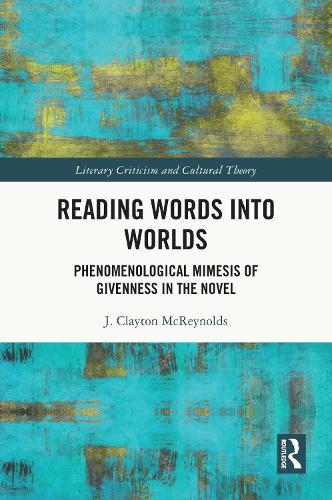
Reading Words into Worlds asks how it is that reading a novel can feel in some ways like being-in-a-world. The book explores how novels give themselves to readers in ways that mimetically resemble our phenomenological reception of given beings in reality. McReynolds refers to this process as phenomenological mimesis of givenness, and he draws on the phenomenological philosophy of Husserl, Heidegger, and Jean-Luc Marion to explore how masterful novels can make reading ink marks on a page feel like seeing things, feeling things, and meeting (even loving) others. McReynolds blends rigorous phenomenological study with a personable style, first laying out his theory in detail and then applying that theory through close studies of his reading experiences of four British realist masterpieces: Defoe’s Robinson Crusoe, Austen’s Northanger Abbey, Eliot’s Middlemarch, and Hardy’s Jude the Obscure. Ultimately, this book offers a grounded phenomenology of novel-reading, illuminating what gives novels such power to not only thrill readers—but to change them.
Full Product Details
Author: J. Clayton McReynolds
Publisher: Taylor & Francis Ltd
Imprint: Routledge
ISBN: 9781032635439
ISBN 10: 1032635436
Pages: 194
Publication Date: 26 December 2025
Audience:
College/higher education
,
Tertiary & Higher Education
Format: Paperback
Publisher's Status: Forthcoming
Availability: Not yet available

This item is yet to be released. You can pre-order this item and we will dispatch it to you upon its release.
Reviews
McReynolds sets out to describe what it is like to feel alive in the world of a novel. He accomplishes this by also making us feel alive in his book; so lively and intimate is his authorial voice, one feels as though he is speaking directly to you. With lucid explanation, he tackles the dense narrative concepts of phenomenology and mimesis, not to mention realism itself. Indeed, McReynolds’ conception of phenomenological realism belongs alongside such fundamental theories as Ian Watt’s formal realism. But his explanatory power does not diminish the magic of novels by mighty giants like Defoe, Austen, Hardy, and Eliot. Rather, this book will leave readers with a renewed sense of wonder at the novel’s power to draw us in to a world, and our own desire to go. -Dr. Kristen Pond, Associate Professor, Baylor University, USA Reading Words Into Worlds is vitally important for any student of the novel. Dr. McReynolds’ work is grounded in phenomenological research, bringing foundational figures such as Heidegger and Ricoeur to bear in explaining what a novel is and how it works. He writes with a no-nonsense lucidity that is rare in recent literary criticism. His theory of “phenomenological mimesis” is not only one of the most cogent explanations of how we read novels, but it also has suggestive implications for making sense of reality itself. -Dr. Cory Grewell, Professor of Literature, Patrick Henry College, USA
Author Information
J. Clayton McReynolds received his Ph.D. in English Literature from Baylor University. He currently teaches literature, history, speech, and writing at Arma Dei Academy. His research interests include the phenomenology of reading, realism, and the rise of the novel, and his work has been published in Dickens Studies Annual and The Journal of Inklings Studies.