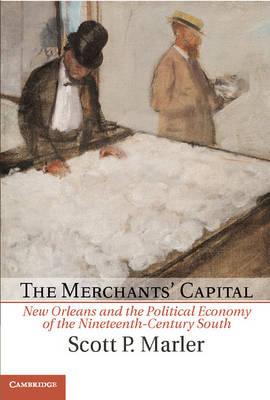
Full Product Details
Author: Scott P. Marler (University of Memphis)
Publisher: Cambridge University Press
Imprint: Cambridge University Press
Dimensions:
Width: 15.80cm
, Height: 2.20cm
, Length: 23.60cm
Weight: 0.600kg
ISBN: 9780521897648
ISBN 10: 0521897645
Pages: 327
Publication Date: 29 April 2013
Audience:
Professional and scholarly
,
College/higher education
,
Professional & Vocational
,
Tertiary & Higher Education
Format: Hardback
Publisher's Status: Active
Availability: Manufactured on demand

We will order this item for you from a manufactured on demand supplier.
Reviews
The Merchants' Capital is one of the most impressive contributions to the literature on the political economy of the nineteenth-century South to have appeared in some time. This broadly conceived and well-researched study of the Crescent City's business community is at once rigorously argued and elegantly written. Marler's long-awaited book is a worthy successor to classics such as Harold D. Woodman's King Cotton and His Retainers and Roger L. Ransom and Richard Sutch's One Kind of Freedom. - Peter A. Coclanis, Albert R. Newsome Distinguished Professor of History, UNC-Chapel Hill Tracing the history of New Orleans and its merchant class from the days of the slave-based Cotton Kingdom through the Civil War and Reconstruction, Scott Marler offers a new perspective on economic development - and lack thereof - in the Southern economy. He places the city's history firmly in the setting of the international cotton trade, but shows how local factors, including the merchants' own short-sightedness, contributed to the long-term decline of New Orleans as a mercantile center. A valuable contribution to Southern history. - Eric Foner, DeWitt Clinton Professor of History, Columbia University We've waited a long time for an in-depth history of the antebellum South's most powerful and dynamic business community. There have been dissertations and articles about New Orleans merchants, and more specialized studies of banking in the Crescent City, but not until Scott Marler's prodigiously researched book has there appeared a full-scale treatment of the subject. Well written and shrewdly insightful, The Merchants' Capital will become a well-thumbed history of a vital subject. - Lawrence N. Powell, Professor Emeritus of History, Tulane University Scott Marler combines deep research with conceptual acuity in an impressive analysis of the Deep South's stunted political economy across the nineteenth century. Shining a much-needed searchlight on the businessmen of New Orleans and its hinterland, The Merchants' Capital explains why New Orleans did not take off like many other North American cities but rather declined into the 'city that care forgot.' - Adam Rothman, Georgetown University The Merchants' Capital tells the riveting story of New Orleans' precipitous economic and political decline during and after the Civil War, from the nerve center of the Cotton Kingdom to a backwater notorious for corruption and poverty. Scott Marler provocatively sets this narrative in a larger context of global economic change. All students of slavery and the South should read this book. - Gavin Wright, William Robertson Coe Professor of American Economic History, Stanford University
'This splendid book offers a meticulous historical study of merchant capitalism in ... New Orleans, a unique port city in the South ... This wonderful study contributes to both southern history and business history and should be required reading in undergraduate and graduate courses.' Elena V. Shabliy, Southern Historian
'This splendid book offers a meticulous historical study of merchant capitalism in ... New Orleans, a unique port city in the South ... This wonderful study contributes to both southern history and business history and should be required reading in undergraduate and graduate courses.' Elena V. Shabliy, Southern Historian 'Prodigiously researched and elegantly argued, The Merchants' Capital deserves a wide readership.' Richard Follett, The Journal of Southern History The Merchants' Capital is one of the most impressive contributions to the literature on the political economy of the nineteenth-century South to have appeared in some time. This broadly conceived and well-researched study of the Crescent City's business community is at once rigorously argued and elegantly written. Marler's long-awaited book is a worthy successor to classics such as Harold D. Woodman's King Cotton and his Retainers and Roger L. Ransom and Richard Sutch's One Kind of Freedom. Peter A. Coclanis, Albert R. Newsome Distinguished Professor of History, University of North Carolina, Chapel Hill Tracing the history of New Orleans and its merchant class from the days of the slave-based Cotton Kingdom through the Civil War and Reconstruction, Scott Marler offers a new perspective on economic development - and lack thereof - in the Southern economy. He places the city's history firmly in the setting of the international cotton trade, but shows how local factors, including the merchants' own short-sightedness, contributed to the long-term decline of New Orleans as a mercantile center. A valuable contribution to Southern history. Eric Foner, DeWitt Clinton Professor of History, Columbia University We've waited a long time for an in-depth history of the antebellum South's most powerful and dynamic business community. There have been dissertations and articles about New Orleans merchants, and more specialized studies of banking in the Crescent City, but not until Scott Marler's prodigiously researched book has there appeared a full-scale treatment of the subject. Well written and shrewdly insightful, The Merchants' Capital will become a well-thumbed history of a vital subject. Lawrence N. Powell, Professor Emeritus of History, Tulane University Scott Marler combines deep research with conceptual acuity in an impressive analysis of the Deep South's stunted political economy across the nineteenth century. Shining a much-needed searchlight on the businessmen of New Orleans and its hinterland, The Merchants' Capital explains why New Orleans did not take off like many other North American cities but rather declined into the 'city that care forgot'. Adam Rothman, Georgetown University The Merchants' Capital tells the riveting story of New Orleans' precipitous economic and political decline during and after the Civil War, from the nerve center of the Cotton Kingdom to a backwater notorious for corruption and poverty. Scott Marler provocatively sets this narrative in a larger context of global economic change. All students of slavery and the South should read this book. Gavin Wright, William Robertson Coe Professor of American Economic History, Stanford University This splendid book offers a meticulous historical study of merchant capitalism in ... New Orleans, a unique port city in the South ... This wonderful study contributes to both southern history and business history and should be required reading in undergraduate and graduate courses. Elena V. Shabliy, Southern Historian Prodigiously researched and elegantly argued, The Merchants' Capital deserves a wide readership. Richard Follett, The Journal of Southern History
Author Information
Scott P. Marler is an Associate Professor of History at the University of Memphis, where he teaches courses in US, Southern, and Atlantic World history. A former editor at the Journal of Southern History, his work was a finalist for the Allen Nevins Dissertation Prize of the Economic History Association, and he has also won awards from the St George Tucker Society and the Louisiana Historical Association.