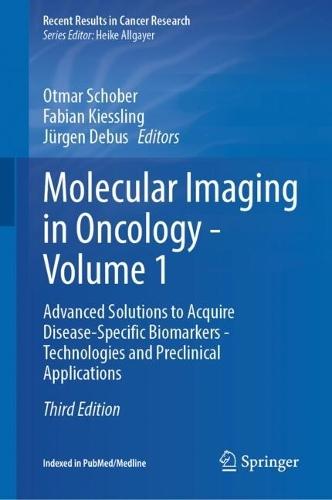
Full Product Details
Author: Otmar Schober ,
Fabian Kiessling ,
Jürgen Debus
Publisher: Springer Nature Switzerland AG
Imprint: Springer Nature Switzerland AG
Edition: Third Edition 2026
ISBN: 9783032153135
ISBN 10: 3032153131
Pages: 615
Publication Date: 19 May 2026
Audience:
Professional and scholarly
,
College/higher education
,
Professional & Vocational
,
Postgraduate, Research & Scholarly
Format: Hardback
Publisher's Status: Active
Availability: Not yet available

This item is yet to be released. You can pre-order this item and we will dispatch it to you upon its release.
Author Information
Otmar Schober was Director of the Department of Nuclear Medicine at the University of Münster from 1988 to 2013 and Deputy Rector of the university from 1994 to 1998. He has extensive expertise in the natural sciences and clinical medicine and has focused on imaging methods and their implementation in preclinical and clinical applications. Professor Schober completed his studies in laser physics with Herbert Welling and in surface physics with Nobel Laureate Gerhard Ertl at the Universities of Hanover and Munich. He received his medical training in Frankfurt, Hanover, and London; Heinz Hundeshagen was his mentor. From 1995 to 2003, he was a German Research Foundation expert reviewer for Radiology, Nuclear Medicine, and Radiation Biology. He has served as Editor-in-Chief of the Journal Nuklearmedizin (2001–2011) and as a coeditor of various international journals. Professor Schober served as coordinator of the Collaborative Research Center on Molecular Cardiovascular Imaging from 1999 to 2013. As a founder of the European Institute for Molecular Imaging, he was the principal investigator at the Cluster of Excellence “Cells in Motion.” Fabian Kiessling leads the Institute for Experimental Molecular Imaging at the RWTH University in Aachen, where he is working to develop novel diagnostic and theranostic concepts, probes, and technologies. Professor Kiessling studied medicine at Heidelberg University and subsequently worked as a resident at the Department of Radiology, German Cancer Research Center (until the end of 2002). In 2003, he moved to the Department of Medical Physics in Radiology as leader of a Molecular Imaging Group. At the same time, he pursued his clinical training, becoming a board-certified radiologist in 2007. He is the author of more than 500 publications and book chapters and has been an editorial board member for various journals, including Radiology, European Radiology, Molecular Imaging and Biology, and npj Imaging. From 2019-2025 he was featured as Highly Cited Researcher by Clarivate Analytics and he has won a number of awards, including the Emil Salzer Prize for Cancer Research and the Richtzenhain Prize. He is a fellow of the World Molecular Imaging Society, served as president of the European Society for Molecular Imaging and is a member of the Academia Europaea and the German Academy of Science and Engineering (acatech). Furthermore, he co-founded the in vivo Contrast GmbH and the SonoMAC GmbH, which both distribute diagnostic probes for preclinical imaging. Jürgen Debus is a medical doctor and holds a PhD in physics. Since 2003 he is full professor and chairman of the department of Radiation Oncology at the Heidelberg University Hospital. In July 2024 he became chief medical director and chairman of the management board of Heidelberg University Hospital. Prof. Debus did pioneering work in modern conformal high precision radiotherapy and significantly contributed to development of IMRT, stereotactic irradiation techniques and particle therapy as director of the department Radiation Oncology of the DKFZ (German Cancer Center). In co-operation with Gesellschaft für Schwerionenforschung (GSI) he introduced carbon ion therapy in Germany that led to the foundation of the Heidelberg Ion beam Therapy center (HIT) in 2009. Since then, he is medical and executive director of the HIT. The scientific activities of Prof. Debus are focused on the optimization and individualization of radiation therapy, especially research and development of ion beam therapy and image guided adaptive radiotherapy with photons and ions.