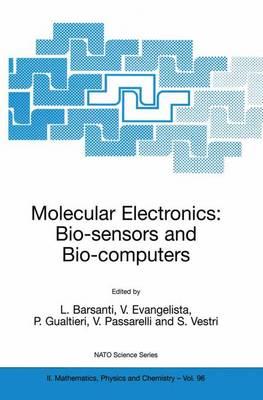
Molecular Electronics: Bio-sensors and Bio-computers

Author:   L. Barsanti ,  V. Evangelista ,  P. Gualtieri ,  V. Passarelli
Publisher:   Kluwer Academic Publishers
Edition:   2003 ed.
Volume:   96
ISBN:  

9781402012112


Pages:   545
Publication Date:   31 March 2003
Format:   Hardback
Availability:   In Print   Availability explained
This item will be ordered in for you from one of our suppliers. Upon receipt, we will promptly dispatch it out to you. For in store availability, please contact us.

Our Price $652.08 Quantity:  
Add to Cart

Share |

Molecular Electronics: Bio-sensors and Bio-computers


Overview

How fast and powerful can computers become? Will it be possible someday to create artificial brains that have intellectual capabilities comparable to those of human beings? The answers to these questions depend to a very great extent on a single factor: how small and dense we can make computer circuits. Scientists have achieved revolutionary advances that may very well radically change the future of computing. DNA, RNA and protein computing is a new computational paradigm that harnesses biological molecules to solve computational problems. There are significant advantages in using biological molecules, since nature has solved similar problems to those encountered in harnessing organic molecules to carry out data manipulation. Biomolecules can be considered electronic elements, built to process information. They could be used as photonic devices in holography, as spatial light modulators, in neural network optical computing, as nonlinear optical devices, and as optical memories. Molecular computers may use a billion times less energy than electronic computers, while storing data in a trillionth of the space. Moreover, computing with biomolecules is highly parallel. In a remarkable series of demonstrations, chemists, physicists and engineers have shown that individual molecules can conduct and switch electric current and store information. Various research projects have been implemented by national and international groups and they have produced a large amount of data using multidisciplinary research strategies, ranging from physics and engineering to chemistry and biology.

Full Product Details

Author:   L. Barsanti ,  V. Evangelista ,  P. Gualtieri ,  V. Passarelli
Publisher:   Kluwer Academic Publishers
Imprint:   Kluwer Academic Publishers
Edition:   2003 ed.
Volume:   96
Dimensions:   Width: 15.50cm , Height: 3.00cm , Length: 23.50cm
Weight:   2.110kg
ISBN:  

9781402012112


ISBN 10:   140201211
Pages:   545
Publication Date:   31 March 2003
Audience:   College/higher education ,  Professional and scholarly ,  Undergraduate ,  Postgraduate, Research & Scholarly
Format:   Hardback
Publisher's Status:   Active
Availability:   In Print   Availability explained
This item will be ordered in for you from one of our suppliers. Upon receipt, we will promptly dispatch it out to you. For in store availability, please contact us.

Table of Contents

Quantum Mechanical Design of Light Driven Molecular Logical Machines and Elements of Molecular Quantum Computers.- Extreme Miniaturization: Molecular-Level Devices and Machines.- Tetrathiafulvalene and its Derivatives as ?-Electron Donating Units in Pseudorotaxanes, Rotaxanes, and Catenaries.- Hybrid Ferroxide - Organic Layers.- Molecular Electronic Devices.- The Lipid Bilayer Principle and Molecular Electronics.- Molecular Control of Electron Transfer Events Within and Between Biomolecules.- Peptide Foldamers as Building Blocks for Ordered Nanomolecular Architectures: A Structural Investigation.- Influence of Substance Structure on Change of Electrochemical Properties of Bilayer Lipid Membranes.- Biomolecular Electronic Device Applications of Bacteriorhodopsin: Three-Dimensional Optical & Holographic Associative Memories, Integrated Biosensors.- Photoinduced Anisotropy and Dynamic Polarization Holography on Bacteriorhodopsin Films for Optical Information Processing.- Bioelectronics: Development of Biosensors, Biofuel-Cells and Circuitry.- Optical Waveguide Lightmode Spectroscopy and Biocomputing.- Biosensors In Flow Conditions For Biological Analytes.- Optical and Electrochemical Biosensors for Express Environmental Monitoring.- An Algorithm Generating Long Sequences of Stimuli in Behavioral Science: a Suitable Test for Biosensors.- Physiological and Artificial Biosensor for Odour Recognition Systems.- Euglena Gracilis Case: a Real Biosensor.- The Future of the Electronics Industry and the Potential of Molecular Electronics.- Development of Future Sensor Generations: Commercial Vs. Technological Aspects.- Molecular Recognition: Synthetic Receptors by Rational Design and Targeted Synthesis.- The Enigma of Creative Problem Solving: A Biocomputing Perspective.

Reviews

Author Information

Tab Content 6

Author Website:  

Countries Available

All regions
Latest Reading Guide

RGJ26


Shopping Cart
Your cart is empty
Shopping cart
Mailing List