Overview
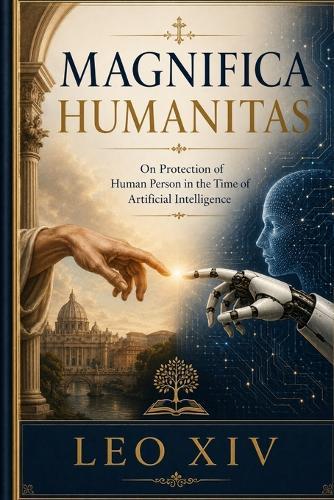
Magnifica Humanitas, Pope Leo XIV's first encyclical, confronts the rise of artificial intelligence and digital power with the Church's timeless wisdom, offering a bold Christian vision for safeguarding human dignity, truth, work, and peace in an age of algorithms and automation. The document couples the computational mind of a pope who holds a mathematics degree from Villanova University with the values of his Augustinian roots. Leo proffers a cajoling, even quaint, argument: In an age of technological disrupters and a pursuit of limitless wealth and power by nations and individuals, the nonstop race for more, better and faster may undermine the fundamental messy beauty of being human. Leo frames the document as scripture come to life. Humanity, he writes, has a choice between two biblical stories. One, the Tower of Babel, in which humans try to ensure their dominance over everything and build to the sky. The other, of the Israelites' reconstruction of Jerusalem, which begins with fasting and prayer and emphasizes shared work and community. MAGNIFICA HUMANITAS (The Grandeur of Humanity) offers a comprehensive moral and spiritual framework for navigating the age of AI. Drawing on the rich tradition of Catholic social doctrine-from Leo XIII to Francis-the encyclical explores the foundations of human dignity, the common good, subsidiarity, solidarity, and social justice as essential principles for discerning the ethical use of emerging technologies.
Full Product Details
Author: Leo XIV
Publisher: Eternal Press
Imprint: Eternal Press
Dimensions:
Width: 15.20cm
, Height: 1.00cm
, Length: 22.90cm
Weight: 0.195kg
ISBN: 9798256035884
Pages: 156
Publication Date: 29 May 2026
Audience:
General/trade
,
General
Format: Paperback
Publisher's Status: Active
Availability: Not yet available

This item is yet to be released. You can pre-order this item and we will dispatch it to you upon its release.
Reviews
""As his predecessor Pope Leo XIII addressed the challenges of the Industrial Revolution in Rerum Novarum one hundred thirty-five years ago, our Holy Father shines the light of the Gospel and the tradition of the Church on the new opportunities and challenges posed by the rise of Artificial Intelligence. The Pope calls us to never lose sight of the inherent dignity of all human life and the moral imperative for technology to support peace and the common good rather than the limited interest of a few,""-- Archbishop Paul S. Coakley, President of the U.S. Conference of Catholic Bishops (USCCB)""The technological future is not a destiny already written. It is a space to be written together, with wisdom, justice, and a conscience capable of remaining human,""--Cardinal Pietro Parolin, Vatican Secretary of State""Pope Leo asserts that ignoring, fearing and rejecting AI are not realistic because AI is part of our reality and is becoming ever more pervasive in virtually every dimension of our lives.Thus, we must find a way to integrate AI into our personal lives and communities in a way that will lead to greater human dignity and flourishing rather than degradation and diminishment,"" --Father Robert J. Spitzer, S.J., Ph.D., the president of the Magis Center and the Spitzer Center""Young people are asking the question, am I studying for something right now, for a job, for a career that's not going to exist in the next decade or so because AI is going to take it over? There's a worry, there's a concern, and they're looking for some direction also. I think this encyclical gives us a very practical roadmap to even how to address some of those very practical issues that people of all ages are looking at,""--Archbishop Ronald Hicks, Archbishop of New York""Magnifica Humanitas' explores being human in the age of artificial intelligence.The future of artificial intelligence will depend upon the moral intelligence of humanity. This makes the greatest question before us not whether machines can become more like human beings, but whether human beings will remember what it truly means to be human,""--Bishop John P. Dolan, Bishop of Phoenix Diocese""Along with its focus on human dignity, 'Magnifica Humanitas' lifts up two other principles that deserve particular attention. First, the dignity of work; what we do shapes who we are, and technology that degrades or devalues human labor isn't progress; it's a great loss. AI should be designed to empower and complement workers, not de-skill or surveil them. Second, care for the vulnerable; how our society treats those in need is the true measure of our commitment to the common good,""--Kim Daniels, Director of the Initiative on Catholic Social Thought and Public Life at Georgetown University.""There is not a tomorrow to begin to think about these issues, because their impact on workplaces, on labour, on immigrants, on families, on political society and on conflicts globally is now, and was yesterday, and will continue tomorrow as well,""--Professor Anna Rowlands, theologian at Durham University.