Awards
- Winner of Choice Outstanding Academic Title 2012
- Winner of Choice Outstanding Academic Title 2017
- Winner of Outstanding Academic Title 2017
- Winner of Yamagata Banto Prize 2019
Overview
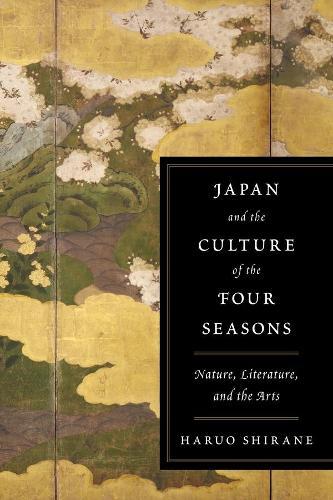
Elegant representations of nature and the four seasons populate a wide range of Japanese genres and media-from poetry and screen painting to tea ceremonies, flower arrangements, and annual observances. In Japan and the Culture of the Four Seasons, Haruo Shirane shows how, when, and why this practice developed and explicates the richly encoded social, religious, and political meanings of this imagery. Refuting the belief that this tradition reflects Japan's agrarian origins and supposedly mild climate, Shirane traces the establishment of seasonal topics to the poetry composed by the urban nobility in the eighth century. After becoming highly codified and influencing visual arts in the tenth and eleventh centuries, the seasonal topics and their cultural associations evolved and spread to other genres, eventually settling in the popular culture of the early modern period. Contrasted with the elegant images of nature derived from court poetry was the agrarian view of nature based on rural life. The two landscapes began to intersect in the medieval period, creating a complex, layered web of competing associations. Shirane discusses a wide array of representations of nature and the four seasons in many genres, originating in both the urban and rural perspective: textual (poetry, chronicles, tales), cultivated (gardens, flower arrangement), material (kimonos, screens), performative (noh, festivals), and gastronomic (tea ceremony, food rituals). He reveals how this kind of ""secondary nature,"" which flourished in Japan's urban architecture and gardens, fostered and idealized a sense of harmony with the natural world just at the moment it was disappearing. Illuminating the deeper meaning behind Japanese aesthetics and artifacts, Shirane clarifies the use of natural images and seasonal topics and the changes in their cultural associations and function across history, genre, and community over more than a millennium. In this fascinating book, the four seasons are revealed to be as much a cultural construction as a reflection of the physical world.
Full Product Details
Author: Haruo Shirane
Publisher: Columbia University Press
Imprint: Columbia University Press
Dimensions:
Width: 15.20cm
, Height: 3.00cm
, Length: 22.90cm
Weight: 0.666kg
ISBN: 9780231152808
ISBN 10: 0231152809
Pages: 336
Publication Date: 20 March 2012
Audience:
General/trade
,
General
Format: Hardback
Publisher's Status: Active
Availability: Manufactured on demand 
We will order this item for you from a manufactured on demand supplier.
Language: English
Table of Contents
List of Illustrations Preface Acknowledgments Historical Periods, Romanization, Names, Titles, and Illustrations Introduction: Secondary Nature, Climate, and Landscape 1. Poetic Topics and the Making of the Four Seasons 2. Visual Culture, Classical Poetry, and Linked Verse 3. Interiorization, Flowers, and Social Ritual 4. Rural Landscape, Social Difference, and Conflict 5. Trans-Seasonality, Talismans, and Landscape 6. Annual Observances, Famous Places, and Entertainment 7. Seasonal Pyramid, Parody, and Botany Conclusion: History, Genre, and Social Community Appendix: Seasonal Topics in Key Texts Notes Bibliography of Recommended Readings in English Selected Bibliography of Secondary and Primary Sources in Japanese Index of Seasonal and Trans-Seasonal Words and Topics Index of Authors, Titles, and Key Terms
Reviews
Japan and the Culture of the Four Seasons provides a compelling account of how Japan has appropriated, interpreted, and valued nature over the centuries. Haruo Shirane's wide-ranging study tracks the culture of nature in Japan and especially the central role of waka in constructing a vision of nature that influenced all the arts. In its breadth, depth, and accessibility, his book is of great value not only to scholars and students of Japan but also to anyone interested in the intersections of art and nature. -- Andrew M. Watsky, Princeton University A tour de force. Haruo Shirane synthesizes the long and complicated encoding of flora, fauna, toponyms, and annual events of the Japanese landscape and calendar, untangling their synchronic connections and their historical development from the eighth to the nineteenth centuries, from the small cuckoo ( hototogisu) as a harbinger of summer in the Kokinshu to the lovemaking of cats as a topic for comic haikai verse in the Edo period. Shirane's book is essential for anyone interested in virtually any genre of the traditional Japanese arts: poetry, costume, painting, noh theater, architecture, tea ceremony, flower arranging -- or even Japanese sweets ( wagashi)! -- Joshua Mostow, University of British Columbia 'Sensitivity to nature' is one of those commonplaces about Japanese tradition that, because of its all-too-easy association with cultural nationalism, tends to set many people's teeth on edge. This engaging and impressive study provides a welcome antidote. Drawing from literary, visual, historical, and religious sources, Haruo Shirane cuts through the cliches to uncover multiple, evolving, and sometimes surprising dimensions of the Japanese relationship with nature from early times to the present. -- Kate Wildman Nakai, professor emerita, Sophia University The book offers a comprehensive view of the subject, replete with fascinating detail, and full scholarly apparatus. -- David Burleigh Japan Times 10/14/2012
Japan and the Culture of the Four Seasons provides a compelling account of how Japan has appropriated, interpreted, and valued nature over the centuries. Shirane's wide-ranging study tracks the culture of nature in Japan, and especially waka's central role in constructing a vision of nature that impacted all the arts. In its breadth, depth, and accessibility, the book is of great value not only to scholars and students of Japan, but anyone interested in the intersections of art and nature. -- Andrew M. Watsky, Princeton University A tour de force. Shirane synthesizes the long and complicated encoding of flora, fauna,toponyms and annual events of the Japanese landscape and calendar, untangling not onlytheir synchronic connections, but also their historical development from the 8th to 19thcentury, from the nightingale (hototogisu) as a harbinger of summer in the Kokinshu tocats' love-making as a topic for comic haikai verse in the Edo period. This book will beessential for anyone interested at all in virtually any genre of the traditional Japanese arts:poetry, costume, painting, noh theater, architecture, tea ceremony, flower arranging -- orJapanese sweets (wagashi)! -- Joshua Mostow, University of British Columbia Sensitivity to nature is one of those commonplaces about Japanese tradition that because of its all-too-easy association with cultural nationalism tends to set many people's teeth on edge. This engaging and impressive study provides a welcome antidote. Drawing from literary, visual, historical, and religious sources, Haruo Shirane cuts through the cliches to uncover multiple, evolving, and sometimes surprising dimensions of the Japanese relationship with nature from early times to the present. -- Kate Wildman Nakai, professor emerita, Sophia University
Japan and the Culture of the Four Seasons provides a compelling account of how Japan has appropriated, interpreted, and valued nature over the centuries. Haruo Shirane's wide-ranging study tracks the culture of nature in Japan and especially the central role of waka in constructing a vision of nature that influenced all the arts. In its breadth, depth, and accessibility, his book is of great value not only to scholars and students of Japan but also to anyone interested in the intersections of art and nature. -- Andrew M. Watsky, Princeton University A tour de force. Haruo Shirane synthesizes the long and complicated encoding of flora, fauna, toponyms, and annual events of the Japanese landscape and calendar, untangling their synchronic connections and their historical development from the eighth to the nineteenth centuries, from the small cuckoo ( hototogisu) as a harbinger of summer in the Kokinshu to the lovemaking of cats as a topic for comic haikai verse in the Edo period. Shirane's book is essential for anyone interested in virtually any genre of the traditional Japanese arts: poetry, costume, painting, noh theater, architecture, tea ceremony, flower arranging -- or even Japanese sweets ( wagashi)! -- Joshua Mostow, University of British Columbia 'Sensitivity to nature' is one of those commonplaces about Japanese tradition that, because of its all-too-easy association with cultural nationalism, tends to set many people's teeth on edge. This engaging and impressive study provides a welcome antidote. Drawing from literary, visual, historical, and religious sources, Haruo Shirane cuts through the cliches to uncover multiple, evolving, and sometimes surprising dimensions of the Japanese relationship with nature from early times to the present. -- Kate Wildman Nakai, professor emerita, Sophia University A comprehensive view of the subject, replete with fascinating detail, and full scholarly apparatus. -- David Burleigh Japan Times 10/14/2012 As accessible as it is erudite, this volume will appeal to those with interest in any aspect of the arts...Highly recommended. Choice October 2012
Author Information
Haruo Shirane is Shincho Professor of Japanese Literature and Culture at Columbia University. He is the author and editor of numerous books on Japanese literature, including, most recently, The Demon at Agi Bridge and Other Japanese Tales; Envisioning The Tale of Genji: Media, Gender, and Cultural Production; Traditional Japanese Literature: An Anthology, Beginnings to 1600; Early Modern Japanese Literature: An Anthology, 1600-1900; Classical Japanese: A Grammar; and Traces of Dreams: Landscape, Cultural Memory, and the Poetry of Basho.
Tab Content 6
Author Website:
Countries Available
All regions
|