Overview
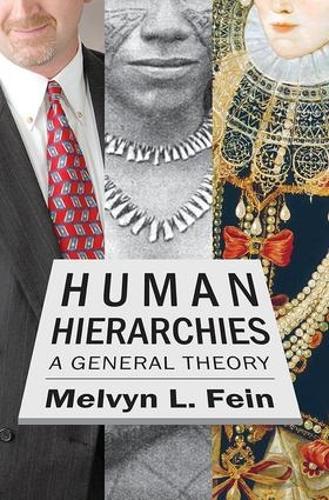
Human beings are hierarchical animals. Always and everywhere, people have developed social ranking systems. These differ dramatically in how they are organized, but the underlying causal mechanisms that create and sustain them are the same. Whether they are on the top or bottom of the heap, people attempt to be superior to some other persons or group. This is the root of Melvyn L. Fein's thesis presented in Human Hierarchies: A General Theory. Fein traces the development of changes from hunter-gatherer times to our own techno-commercial society. In moving from small to large communities, humans went from face-to-face contests for superiority to more anonymous and symbolic ones. Societies evolved from hunting bands where the parties knew each other through big-men societies, chieftainships, agrarian empires, patronage chains, caste societies, estate systems, and market-oriented democracies. Where once small groupings were organized primarily by strong forces such as personal relationships, the now standard large groupings are more dependent on weaker forces such as those provided by social roles. Bureaucracies and professional roles have become prominent. Bureaucracies allow large-scale organizations to maintain control of people by limiting the potential destructiveness of unregulated tests of strength and by clarifying chains of command. Their rigidity and unresponsiveness requires that they be supplemented by professional roles. At the same time, a proliferation of self-motivated experts delegate authority downward, thereby introducing a more flexible decentralization. This analysis is a unique and significant advance in both the sociology and anthropology of stratification among humans.
Full Product Details
Author: Melvyn L. Fein
Publisher: Taylor & Francis Inc
Imprint: Routledge
Dimensions:
Width: 15.20cm
, Height: 2.50cm
, Length: 22.90cm
Weight: 0.657kg
ISBN: 9781412845960
ISBN 10: 1412845963
Pages: 408
Publication Date: 15 June 2012
Audience:
General/trade
,
General
Format: Hardback
Publisher's Status: Active
Availability: In Print

This item will be ordered in for you from one of our suppliers. Upon receipt, we will promptly dispatch it out to you. For in store availability, please contact us.
Reviews
<p> Starting from a position that takes as given a liberal, neo-Marxist orientation in the social sciences, Fein (Kennesaw State Univ.) argues that this has wrongly shifted focus from the scientific study of hierarchies in human societies to philosophical and moralistic construction of inequalities, and seeks to recuperate a scientific view of hierarchy as innately human, probably biologically determined. Those who see conservative values as marginalized and penalized in contemporary academia will find resonance with these arguments.... Recommended. <p> --F. W. Fleach, Choice
Starting from a position that takes as given a liberal, neo-Marxist orientation in the social sciences, Fein (Kennesaw State Univ.) argues that this has wrongly shifted focus from the scientific study of hierarchies in human societies to philosophical and moralistic construction of inequalities, and seeks to recuperate a scientific view of hierarchy as innately human, probably biologically determined. Those who see conservative values as marginalized and penalized in contemporary academia will find resonance with these arguments.... Recommended. --F. W. Fleach, Choice Starting from a position that takes as given a liberal, neo-Marxist orientation in the social sciences, Fein (Kennesaw State Univ.) argues that this has wrongly shifted focus from the scientific study of hierarchies in human societies to philosophical and moralistic construction of inequalities, and seeks to recuperate a scientific view of hierarchy as innately human, probably biologically determined. Those who see conservative values as marginalized and penalized in contemporary academia will find resonance with these arguments.... Recommended. --F. W. Fleach, Choice -Starting from a position that takes as given a liberal, -neo-Marxist- orientation in the social sciences, Fein (Kennesaw State Univ.) argues that this has wrongly shifted focus from the scientific study of hierarchies in human societies to philosophical and moralistic construction of inequalities, and seeks to recuperate a scientific view of hierarchy as innately human, probably biologically determined. Those who see conservative values as marginalized and penalized in contemporary academia will find resonance with these arguments.... Recommended.- --F. W. Fleach, Choice
-Starting from a position that takes as given a liberal, -neo-Marxist- orientation in the social sciences, Fein (Kennesaw State Univ.) argues that this has wrongly shifted focus from the scientific study of hierarchies in human societies to philosophical and moralistic construction of inequalities, and seeks to recuperate a scientific view of hierarchy as innately human, probably biologically determined. Those who see conservative values as marginalized and penalized in contemporary academia will find resonance with these arguments.... Recommended.- --F. W. Fleach, Choice Starting from a position that takes as given a liberal, neo-Marxist orientation in the social sciences, Fein (Kennesaw State Univ.) argues that this has wrongly shifted focus from the scientific study of hierarchies in human societies to philosophical and moralistic construction of inequalities, and seeks to recuperate a scientific view of hierarchy as innately human, probably biologically determined. Those who see conservative values as marginalized and penalized in contemporary academia will find resonance with these arguments.... Recommended. --F. W. Fleach, Choice Starting from a position that takes as given a liberal, neo-Marxist orientation in the social sciences, Fein (Kennesaw State Univ.) argues that this has wrongly shifted focus from the scientific study of hierarchies in human societies to philosophical and moralistic construction of inequalities, and seeks to recuperate a scientific view of hierarchy as innately human, probably biologically determined. Those who see conservative values as marginalized and penalized in contemporary academia will find resonance with these arguments.... Recommended. --F. W. Fleach, Choice
Author Information
Melvyn L. Fein is professor of sociology at Kennesaw State University in Georgia and is the editor of the Journal of Public and Professional Sociology.