Overview
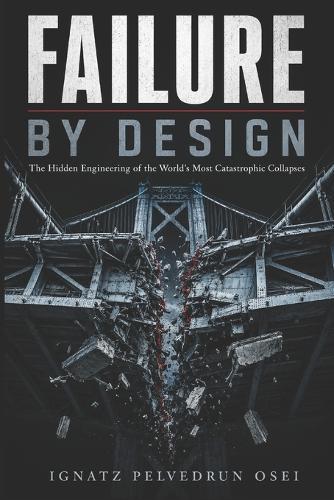
The bridge that killed thirteen people in Minneapolis had been inspected. Repeatedly. By qualified engineers. Following federal standards. For forty years. The gusset plate that failed was undersized on the day it was drawn in 1967. It was still undersized the morning of August 1, 2007, when 140,000 vehicles drove across it. Nobody caught it. Nobody was looking for it. The inspection framework did not include it. That is not an accident. That is a design. Ignatz Pelvedrun Osei spent years inside the world's most consequential engineering failure investigations, reading the reports that governments release and the depositions that lawyers bury, tracing the specific, measurable distance between what engineers knew and what they did, between what inspectors were told to look for and what was actually killing people. What he found was not incompetence. It was something more unsettling: systems working exactly as designed, producing catastrophe on schedule. Failure by Design explains, with the precision of a fracture mechanics report and the momentum of a thriller, why the Tacoma Narrows Bridge fell on a Tuesday morning when the engineering science that could have saved it already existed in aeronautics. Why de Havilland's Comet, the most admired airliner on earth in 1952, was destroying itself from the corners of its own windows before its first passengers boarded. Why Roger Boisjoly wrote a memo the night before Challenger launched, telling his managers exactly what would happen, and why the launch happened anyway, and why seventeen years later Columbia's crew died for the same organizational reason with different subject matter. This is not a book about disasters. Disasters are what you call something when you do not understand it yet. This is a book about mechanisms: the specific, traceable, reproducible sequence by which an organization decides that an anomaly is acceptable, repeats that decision until the anomaly becomes normal, and then discovers, in eleven seconds or seventy-three or forty-five, that normal was the wrong word. Inside: the metallurgy of why aircraft aluminum has no endurance limit and what that means for every fuselage currently in the air. The organizational sociology of why technically sophisticated institutions make the same class of decision error under schedule pressure. The hydraulics of why a dam can survive a wave 250 meters high while the valley below it ceases to exist. The post-tensioned concrete failure mode hiding inside hundreds of bridges for fifty years, invisible to every inspection protocol currently in use. Each chapter is a different failure. Each failure is a different mechanism. Together they form the most comprehensive account ever written of how engineered systems, designed by brilliant people, built by skilled hands, inspected by diligent professionals, arrive at the moment when they stop. You have crossed bridges today. You will board aircraft. The failures in this book are not historical curiosities. The latent conditions they describe, the undersized connection, the corroded tendon, the normalized deviation, the engineer whose concern was heard but not acted on, are present right now in structures you use, waiting for the load combination or the cold morning that completes the sequence. Nothing here is speculation. Everything failed. The records exist. The investigators were thorough. This is what they found.
Full Product Details
Author: Ignatz Pelvedrun Osei
Publisher: Independently Published
Imprint: Independently Published
Dimensions:
Width: 15.20cm
, Height: 0.90cm
, Length: 22.90cm
Weight: 0.218kg
ISBN: 9798198316874
Pages: 156
Publication Date: 23 May 2026
Audience:
General/trade
,
General
Format: Paperback
Publisher's Status: Active
Availability: Available To Order

We have confirmation that this item is in stock with the supplier. It will be ordered in for you and dispatched immediately.