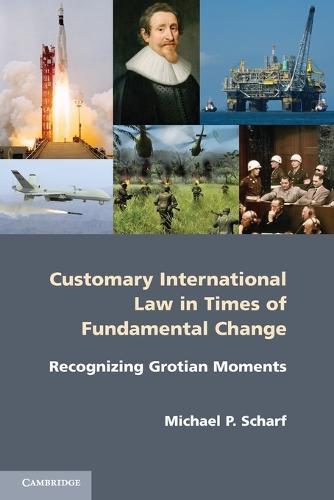
Full Product Details
Author: Michael P. Scharf (Case Western Reserve University, Ohio)
Publisher: Cambridge University Press
Imprint: Cambridge University Press
Dimensions:
Width: 15.20cm
, Height: 1.30cm
, Length: 22.70cm
Weight: 0.320kg
ISBN: 9781107610323
ISBN 10: 110761032
Pages: 237
Publication Date: 31 May 2013
Audience:
Professional and scholarly
,
Professional & Vocational
Format: Paperback
Publisher's Status: Active
Availability: Manufactured on demand

We will order this item for you from a manufactured on demand supplier.
Reviews
This is not a safe book. Virtually everything that Scharf argues is contestable: his premise that customary law remains important in an age of treaties, his contention that there is a third element to customary law (other than state practice and opinio juris), and, of course, his conclusions that Nuremberg, the Truman Proclamation, developments in space law, and the ICTY's Tadic decision were Grotian moments but R2P and post 9/11 efforts to re-interpret self-defense have (so far) not been. Readers will debate Scharf's thesis and how he applies to his six case studies for years to come. What is not debatable is that his book is a significant contribution to explaining how custom emerges and changes. With it, Scharf becomes a custom pioneer of a different kind than the states and institutions that he addresses. -- Jose E. Alvarez, Herbert and Rose Rubin Professor of International Law, New York University School of Law; co-editor in chief, American Journal of International Law Michael Scharf's Customary International Law in Times of Fundamental Change: Recognizing Grotian Moments is a masterful look at when and how radical developments accelerate the emergence of customary international law (described as Grotian Moments ). Scharf's careful development of the concept of Grotian Moments is to be applauded. His book closely analyses six scenarios from recent history in order to better identify both when such moments occur and when it seems like they might occur but nevertheless do not materialize. Why have some controversial legal pronouncements, such as joint criminal enterprise liability and the Tadic Appeals Chamber's holding on the scope of ICTY's provision regarding violations of the laws or customs of war, rapidly gained acceptance as customary international law? Why have other controversial legal pronouncements, such as the responsibility to protect doctrine and the recent expansion of the concept of anticipatory self-defense, not gained such rapid acceptance? Scharf newest work gives careful scrutiny to these legal issues and many others, and what results is a piece of scholarship from which international courts from this point forward can use to understand when customary international law develops and, just as importantly, why. -- Judge Christine Van den Wyngaert, International Criminal Court
Author Information
Michael Scharf is the John Deaver Drinko-Baker and Hostetler Professor of Law and Associate Dean for Global Legal Studies at Case Western Reserve University School of Law. Scharf is the author of fifteen books, three of which have won book of the year awards. During the elder Bush and Clinton Administrations, Scharf served in the Office of the Legal Advisor of the US Department of State, where he held the positions of Attorney-Advisor for Law Enforcement and Intelligence, Attorney-Advisor for United Nations Affairs, and delegate to the United Nations Human Rights Commission. In February 2005, Scharf and the Public International Law and Policy Group, a non-governmental organization he co-founded and directs, were nominated for the Nobel Peace Prize by the prosecutor of an international criminal tribunal for the work they have done to help in the prosecution of major war criminals.