Overview
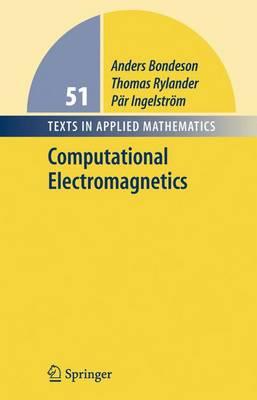
Describes most popular computational methods used to solve problems in electromagnetics Matlab code is included throughout, so that the reader can implement the various techniques discussed Exercises included
Full Product Details
Author: Anders Bondeson ,
Thomas Rylander ,
Par Ingelstrom
Publisher: Springer-Verlag New York Inc.
Imprint: Springer-Verlag New York Inc.
Volume: v. 51
Dimensions:
Width: 15.60cm
, Height: 1.50cm
, Length: 23.40cm
Weight: 0.532kg
ISBN: 9780387261584
ISBN 10: 0387261583
Pages: 252
Publication Date: 15 August 2005
Audience:
College/higher education
,
Professional and scholarly
,
Undergraduate
,
Postgraduate, Research & Scholarly
Replaced By: 9781461453505
Format: Hardback
Publisher's Status: Out of Print
Availability: In Print

Limited stock is available. It will be ordered for you and shipped pending supplier's limited stock.
Reviews
From the reviews: <p> This book is an introductory textbook on computational electromagnetics. It was developed for an undergraduate level class for engineering students at Chalmers University of Technology, G\ {o}teborg, Sweden. It is volume number 51 in the series Texts in Applied Mathematics, which encourages the teaching of new courses. The prerequisites are basic electromagnetic field theory, numerical analysis, and computer programming. The book begins with a brief introduction to Maxwell's equations of electromagnetism. This is followed by a brief chapter on numerical error, resolution, convergence, and extrapolation. Next, finite difference approximations of partial differential equations are presented. Some electromagnetic eigenvalue problems are discussed in the following chapter. With this foundation, the authors devote most of the rest of the book to three widely used methods in computational electromagnetics: the finite-difference time-domain method, the finite element method, and the method of moments. The final chapter contains a brief description of some of the other approaches to CEM and discusses some of the strengths and weaknesses of the various methods. Fifteen numerical algorithms that are presented in the book are implemented as MATLAB programs that may be downloaded from the authors' website. Chapter sections generally end with some review questions, while chapters generally end with a summary, and some problems and computer projects. (Philip Huddleston, Mathematical Reviews) <p> The authors focus on the solution of Maxwella (TM)s equations by means of the Finite Difference Method (FDM), and the Method of Moments (MoM). a ] In order to help the reader tocheck his knowledge and to understand the theory each of the Chapters a ] contains the parts Review Questions, Summary, Problems, and Computer Projects, the last with implementation tasks. The well-written monograph is devoted to students at the undergraduate level, but is also useful for practising engineers. (Georg Hebermehl, Zentralblatt MATH, Vol. 1111 (8), 2007)
From the reviews: This book is an introductory textbook on computational electromagnetics. It was developed for an undergraduate level class for engineering students at Chalmers University of Technology, G\ {o}teborg, Sweden. It is volume number 51 in the series Texts in Applied Mathematics, which encourages the teaching of new courses. The prerequisites are basic electromagnetic field theory, numerical analysis, and computer programming. The book begins with a brief introduction to Maxwell's equations of electromagnetism. This is followed by a brief chapter on numerical error, resolution, convergence, and extrapolation. Next, finite difference approximations of partial differential equations are presented. Some electromagnetic eigenvalue problems are discussed in the following chapter. With this foundation, the authors devote most of the rest of the book to three widely used methods in computational electromagnetics: the finite-difference time-domain method, the finite element method, and the method of moments. The final chapter contains a brief description of some of the other approaches to CEM and discusses some of the strengths and weaknesses of the various methods. Fifteen numerical algorithms that are presented in the book are implemented as MATLAB programs that may be downloaded from the authors' website. Chapter sections generally end with some review questions, while chapters generally end with a summary, and some problems and computer projects. (Philip Huddleston, Mathematical Reviews) The authors focus on the solution of Maxwell's equations by means of the Finite Difference Method (FDM), and the Method of Moments (MoM). ... In order to help the reader to check his knowledge and to understand the theory each of the Chapters ... contains the parts Review Questions, Summary, Problems, and Computer Projects, the last with implementation tasks. The well-written monograph is devoted to students at the undergraduate level, but is also useful for practising engineers. (Georg Hebermehl, Zentralblatt MATH, Vol. 1111 (8), 2007) This book was conceived as a text in computational electromagnetics (CEM), and its intended audience includes senior undergraduate and graduate students. The material is closely related to the course that Professor Anders Bondeson taught at Chalmers University in Sweden ... . Review questions, problems, and computer projects at the end of each chapter are helpful, and the MATLAB code included in the text is definitely a plus. (Igor Tsukerman, SIAM Review, Vol. 49 (1), 2007)
From the reviews: This book is an introductory textbook on computational electromagnetics. It was developed for an undergraduate level class for engineering students at Chalmers University of Technology, G\ {o}teborg, Sweden. It is volume number 51 in the series Texts in Applied Mathematics, which encourages the teaching of new courses. The prerequisites are basic electromagnetic field theory, numerical analysis, and computer programming. The book begins with a brief introduction to Maxwell's equations of electromagnetism. This is followed by a brief chapter on numerical error, resolution, convergence, and extrapolation. Next, finite difference approximations of partial differential equations are presented. Some electromagnetic eigenvalue problems are discussed in the following chapter. With this foundation, the authors devote most of the rest of the book to three widely used methods in computational electromagnetics: the finite-difference time-domain method, the finite element method, and the method of moments. The final chapter contains a brief description of some of the other approaches to CEM and discusses some of the strengths and weaknesses of the various methods. Fifteen numerical algorithms that are presented in the book are implemented as MATLAB programs that may be downloaded from the authors' website. Chapter sections generally end with some review questions, while chapters generally end with a summary, and some problems and computer projects. (Philip Huddleston, Mathematical Reviews) The authors focus on the solution of Maxwell's equations by means of the Finite Difference Method (FDM), and the Method of Moments (MoM). ! In order to help the reader to check his knowledge and to understand the theory each of the Chapters ! contains the parts Review Questions, Summary, Problems, and Computer Projects, the last with implementation tasks. The well-written monograph is devoted to students at the undergraduate level, but is also useful for practising engineers. (Georg Hebermehl, Zentralblatt MATH, Vol. 1111 (8), 2007) This book was conceived as a text in computational electromagnetics (CEM), and its intended audience includes senior undergraduate and graduate students. The material is closely related to the course that Professor Anders Bondeson taught at Chalmers University in Sweden ! . Review questions, problems, and computer projects at the end of each chapter are helpful, and the MATLAB code included in the text is definitely a plus. (Igor Tsukerman, SIAM Review, Vol. 49 (1), 2007)