Overview
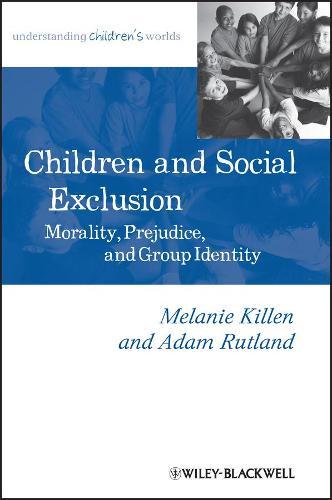
Children and Social Exclusion: Morality, Prejudice, and Group Identity explores the origins of prejudice and the emergence of morality to explain why children include some and exclude others. Formulates an original theory about children’s experiences with exclusion and how they understand the world of discrimination based on group membership Brings together Social Domain Theory and Social Identity Theory to explain how children view exclusion that often results in prejudice, and inclusion that reflects social justice and morality Presents new research data consisting of in-depth interviews from childhood to late adolescence, observational findings with peer groups, and experimental paradigms that test how children understand group dynamics and social norms, and show either group bias or morality Illustrates data with direct quotes from children along with diagrams depicting their social understanding Presents new insights about the origins of prejudice and group bias, as well as morality and fairness, drawn from extensive original data
Full Product Details
Author: Melanie Killen (University of Maryland, USA) ,
Adam Rutland (University of Kent, UK)
Publisher: John Wiley and Sons Ltd
Imprint: Wiley-Blackwell
Dimensions:
Width: 15.20cm
, Height: 1.10cm
, Length: 22.90cm
Weight: 0.322kg
ISBN: 9781118571859
ISBN 10: 1118571851
Pages: 256
Publication Date: 10 May 2013
Audience:
Professional and scholarly
,
Professional & Vocational
Format: Paperback
Publisher's Status: Active
Availability: Out of stock

The supplier is temporarily out of stock of this item. It will be ordered for you on backorder and shipped when it becomes available.
Reviews
<p> Killen and Rutland provide expert broad-ranging reviewsof relevant theories, research, and interventions and conclude withan integrative framework for understanding and addressing peerexclusion. (Journal of Applied DevelopmentalPsychology, 2012) Highly recommended. Upper-division undergraduates through facultyand professionals. (Choice, 1 November 2011) <p> In sum, as we continue to understand and decipher thedevelopment of exclusion and inclusion in children, the frameworkprovided by Killen and Rutland will be an unequivocal guide andimpetus for a myriad of empirical studies in the human developmentfield. After reading this impressive book, I believe the future ofscholarship in this area (and our collective future) is bright andexciting! (Human Development Journal, 2013)
<p> Killen and Rutland provide expert broad-ranging reviews of relevant theories, research, and interventions and conclude with an integrative framework for understanding and addressing peer exclusion. ( Journal of Applied Developmental Psychology , 2012) Highly recommended. Upper-division undergraduates through faculty and professionals. (Choice, 1 November 2011)
Author Information
Melanie Killen is Professor of Human Development, Professor of Psychology (Affiliate), and Associate Director for the Center for Children, Relationships, and Culture at the University of Maryland. She is a Fellow of both the American Psychological Association and the Association for Psychological Science. She is also a recipient of the Distinguished Scholar-Teacher Award by the Provost from the University of Maryland. Her book with Dan Hart, Morality in Everyday Life: Developmental Perspectives (1995), received the outstanding book award from AERA, and her book with Sheri Levy, Intergroup Attitudes and Relations from Childhood to Adulthood, received an Honorable Mention for the Otto Klineberg Memorial Prize from SPSSI. Her research examines the development of morality, intergroup attitudes, exclusion and inclusion, peer relationships, prejudice, culture, and how social experience is related to social-cognitive development. Adam Rutland is Professor of Developmental Psychology at the Child Development Unit and Centre for the Study of Group Processes in the School of Psychology at the University of Kent. Previously he has been a British Academy Post-doctoral Fellow at the University of Surrey and been a member of Faculty at the University of Aberdeen. His research examines the development of children's prejudice and social identities. He has conducted recent research into when and how children learn to self-present their explicit attitudes; how intergroup contact can reduce children's prejudice; children's exclusion of peers within groups and acculturation amongst ethnic minority children.