Overview
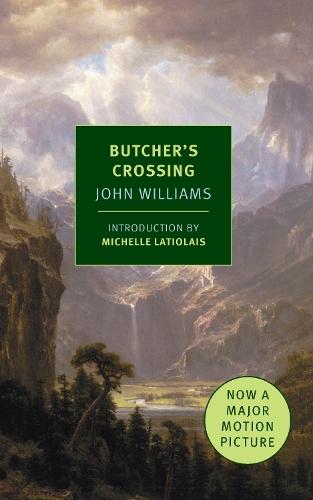
In his National Book Award-winning novel Augustus, John Williams uncovered the secrets of ancient Rome. With Butcher's Crossing, his fiercely intelligent, beautifully written western, Williams dismantles the myths of modern America. It is the 1870s, and Will Andrews, fired up by Emerson to seek ""an original relation to nature,"" drops out of Harvard and heads west. He washes up in Butcher's Crossing, a small Kansas town on the outskirts of nowhere. Butcher's Crossing is full of restless men looking for ways to make money and ways to waste it. Before long Andrews strikes up a friendship with one of them, a man who regales Andrews with tales of immense herds of buffalo, ready for the taking, hidden away in a beautiful valley deep in the Colorado Rockies. He convinces Andrews to join in an expedition to track the animals down. The journey out is grueling, but at the end is a place of paradisal richness. Once there, however, the three men abandon themselves to an orgy of slaughter, so caught up in killing buffalo that they lose all sense of time. Winter soon overtakes them: they are snowed in. Next spring, half-insane with cabin fever, cold, and hunger, they stagger back to Butcher's Crossing to find a world as irremediably changed as they have been.
Full Product Details
Author: John Williams ,
Michelle Latiolais
Publisher: New York Review Books
Imprint: NYRB Classics
Edition: Main
Dimensions:
Width: 12.80cm
, Height: 1.60cm
, Length: 20.30cm
Weight: 0.283kg
ISBN: 9781590171981
ISBN 10: 1590171985
Pages: 296
Publication Date: 16 January 2007
Audience:
General/trade
,
General
Format: Paperback
Publisher's Status: Active
Availability: In Print

This item will be ordered in for you from one of our suppliers. Upon receipt, we will promptly dispatch it out to you. For in store availability, please contact us.
Reviews
"'One of the finest books about the elusive nature of the West ever written...It's a graceful and brutal story of isolated men gone haywire.' Time Out New York 'Harsh and relentless yet muted in tone, Butcher's Crossing paved the way for Cormac McCarthy. It was perhaps the first and best revisionist western.' The New York Times Book Review 'One of the finest novels of the West ever to come out of the West.' The Denver Post 'This story about the hunt of one of the last great buffalo herds ""becomes a young man's search for the integrity of his own being...The characters are defined, the events lively, the place, the smells, the sounds right. And the prose is superb, a rarity in writing about the west. More, John Williams.' The Chicago Tribune 'John Williams's unsparing novels express a highly qualified though resilient optimism about our ability to salvage something of value from life's impossible conditions. Along with the necessary isolation of the artist, he conveys the sobering if startled recognition--perhaps with his own career in mind--of the transitory triumph of art.' Times Literary Supplement"
One of the finest books about the elusive nature of the West ever written...It's a graceful and brutal story of isolated men gone haywire. -- Time Out New York <br> Harsh and relentless yet muted in tone, Butcher's Crossing paved the way for Cormac McCarthy. It was perhaps the first and best revisionist western. -- The New York Times Book Review <br> One of the finest novels of the West ever to come out of the West. -- The Denver Post <br> Williams didn't write much compared with some novelists, but everything he did was exceedingly fine...it's a shame that he's not more often read today...But it's great that at least two of his novels [ Stoner, Butcher's Crossing ] have found their way back into print. -- The Denver Post <br> Reading John Williams-even to have done so at the time these novels were written-is an exercise in nostalgia, a nostalgia found also in writers like Willa Cather, for whom the West represented a lost redoubt of intellectual dignity...It is tempting to say that Cather's tradition flagged because the West has changed - it is no longer anybody's bildungsroman-but it is safer to say that writers as talented and right-minded as John Williams are not naturally plentiful. - New York Sun <br>This story about the hunt of one of the last great buffalo herds becomes a young man's search for the integrity of his own being...The characters are defined, the events lively, the place, the smells, the sounds right. And the prose is superb, a rarity in writing about the west. More, John Williams. -- The Chicago Tribune <br> John Williams's unsparing novels express a highly qualified though resilient optimism about our ability to salvage something of value from life'simpossible conditions. Along with the necessary isolation of the artist, he conveys the sobering if startled recognition--perhaps with his own career in mind--of the transitory triumph of art. -- Times Literary Supplement
Author Information
John Williams (1922-1994) was born and raised in Northeast Texas. Despite a talent for writing and acting, Williams flunked out of a local junior college after his first year. He reluctantly joined the war effort, enlisting in the Army Air Corps, and managing to write a draft of his first novel while there. Once home, Williams found a small publisher for the novel and enrolled at the University of Denver, where he was eventually to receive both his B.A. and M.A., and where he was to return as an instructor in 1954. Williams remained on the staff of the creative writing program at the University of Denver until his retirement in 1985. During these years, he was an active guest lecturer and writer, publishing two volumes of poetry and three novels, Butcher's Crossing, Stoner, and the National Book Award-winning Augustus. Michelle Latiolais is a member of the Programs in Writing at the University of California at Irvine where she is associate professor of English. She is the author of the novel Even Now.