Overview
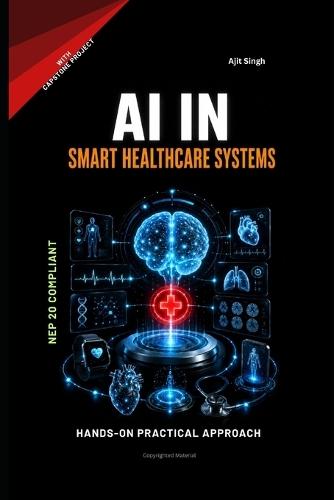
""AI in Smart Healthcare Systems"" is a definitive, end-to-end guide designed to bridge the gap between academic AI theory and real-world industrial implementation. Aligned strictly with the NEP 2020 and the AICTE syllabus, this text provides a comprehensive blueprint for designing, building, setting up, deploying, and maintaining Artificial Intelligence applications specific to the healthcare sector. Spanning exactly 4 to 5 pages of deeply detailed instructional framework, this section outlines the core mechanics, philosophy, and features of the text. Philosophy The driving philosophy behind this book is ""Democratization through Implementation."" For too long, Artificial Intelligence has been treated as a highly abstract, mathematically dense subject restricted to research laboratories. This book upends that tradition. I worked upon the principle that AI is a tool, and like any tool, its true value is only realized when it is put into practice. The philosophy here is strictly application-oriented. I prioritized the how over the what. Instead of spending pages proving mathematical theorems, this book dedicates its space to writing code, configuring servers, designing system architectures, and executing live models. Key Features 1. NEP 2020 & AICTE Compliant: The curriculum matches modern academic requirements, emphasizing skill enhancement, multi-disciplinary applications, and employability. 2. End-to-End Implementation: Covers the entire spectrum-from scratch, to design, build, setup, deployment, implementation, and final production. 3. Industry-Oriented: Focuses heavily on the trends, requirements, and compliance standards of the real-life healthcare industry (e.g., handling Electronic Health Records, IoMT). 4. Strictly Title-Focused: No filler content. Every paragraph directly relates to integrating AI into smart healthcare systems. 5. Live DIY Capstone Project: Chapter 10 is exclusively dedicated to a complete, working capstone project with fully explained, step-by-step code. 6. Comprehensive Chapter Structure: Every chapter essentially includes the design, model, architecture, framework, services, components, implementation, deployment, functioning, future scope, and mode of operations. Key Takeaways Upon completing this text, the reader will not merely hold theoretical knowledge; you will possess tangible, demonstratable skills. Key takeaways include: 1. Architectural Mastery: The ability to design the complete framework and architecture of smart healthcare systems. 2. Model Development: Practical competency in building both Machine Learning and Deep Learning models tailored for medical diagnostics, image analysis, and predictive healthcare. 3. Deployment Proficiency: The exact know-how to take a local AI model and deploy it into a live, production-ready environment, making it accessible to end-users (doctors and patients). 4. Code Fluency: A deep understanding of industry-standard programming for AI, achieved through the continuous hands-on practicals provided in every chapter. 5. Portfolio Readiness: The successful completion of the DIY Capstone Project in Chapter 10 leaves the reader with a fully functional, live AI application that can be showcased to potential employers as proof of their industry readiness. Disclaimer: Earnest request from the Author. Kindly go through the table of contents and refer kindle edition for a glance on the related contents. Thank you for your kind consideration!
Full Product Details
Author: Ajit Singh
Publisher: Independently Published
Imprint: Independently Published
Dimensions:
Width: 15.20cm
, Height: 1.70cm
, Length: 22.90cm
Weight: 0.435kg
ISBN: 9798198672864
Pages: 326
Publication Date: 26 May 2026
Audience:
General/trade
,
General
Format: Paperback
Publisher's Status: Active
Availability: Available To Order

We have confirmation that this item is in stock with the supplier. It will be ordered in for you and dispatched immediately.